
Why most product recommendation chatbots fail with complex catalogs – and what to look for instead
TL;DR
- Generic website chatbots fail on complex product catalogues not because they are badly configured but because they were never designed for this kind of search.
- The core problem is sequence: most chatbots search first and try to filter later. For compatibility-based catalogues the approach has to be the opposite.
- A pre-filtering step – before the AI even begins searching – is what separates a chatbot that gets it right from one that returns the wrong part with confidence.
- The fix is not a custom-built solution costing six figures. It is a chatbot built with the right workflow, the right model and the right data – and maintained as your catalogue changes.
- If your customers regularly ask “will this work with my vehicle / machine / system” and your chatbot gets it wrong, that is a solvable problem.
How do you stop an AI chatbot from making things up?
TL;DR
- AI chatbots make things up not because they are broken but because they are designed to
- The causes are often subtle: conflicting source material, missing fallback instructions, the wrong AI model for the job or content that isn’t synced with your live website
- The fix has two parts: disciplined setup before launch and active monitoring after it
- Most platforms give you a dashboard. Catching problems before your customers do requires a human in the loop
- If you want a website chatbot that stays accurate without you having to manage it yourself, that is exactly what we build
Why do you need someone to help set up a Website AI chatbot – can’t you just do it yourself?
TL;DR
- Yes, you can set up a basic AI chatbot yourself in an afternoon. That’s not the hard part.
- Australian workers already spend 6.5 hours a week “botsitting” – the unglamorous work of keeping AI tools usable. Most business owners don’t budget for this.
- 74% of deployed AI chatbots get shut down or rolled back within their first year, mainly due to poor setup, messy data and zero ongoing monitoring – not because the technology doesn’t work.
- The setup is the easy 10%. The ongoing training, monitoring and refinement is the 90% that determines whether it actually helps your business.
How many sales are you losing because no one answered after hours?
TL;DR
- 35% of all Australian online transactions happen between 7pm and 10pm – when most store teams have gone home.
- Businesses that don’t respond within 30 minutes are 21 times less likely to qualify a lead.
- An AI chatbot set up properly can cut missed after-hours enquiries from around 70% down to less than 10%.
- You don’t need to hire night-shift staff. You need a smarter setup that works while you sleep.
What Small Businesses Should Expect From a Custom Chatbot Setup
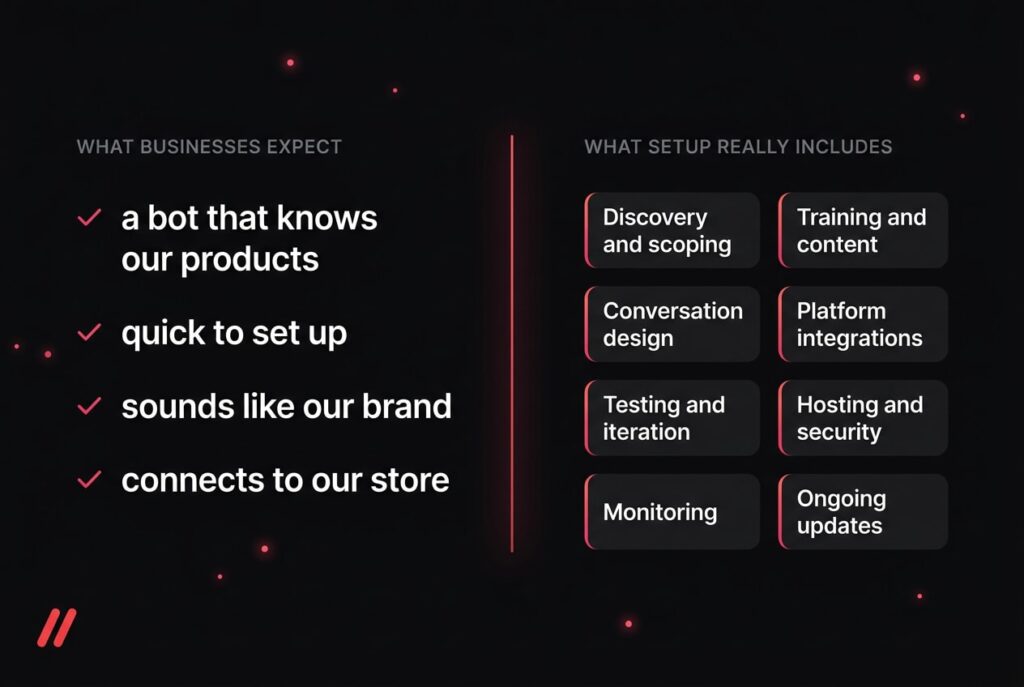
TL;DR
- 35% of all Australian online transactions happen between 7pm and 10pm – when most store teams have gone home.
- Businesses that don’t respond within 30 minutes are 21 times less likely to qualify a lead.
- An AI chatbot set up properly can cut missed after-hours enquiries from around 70% down to less than 10%.
- You don’t need to hire night-shift staff. You need a smarter setup that works while you sleep.
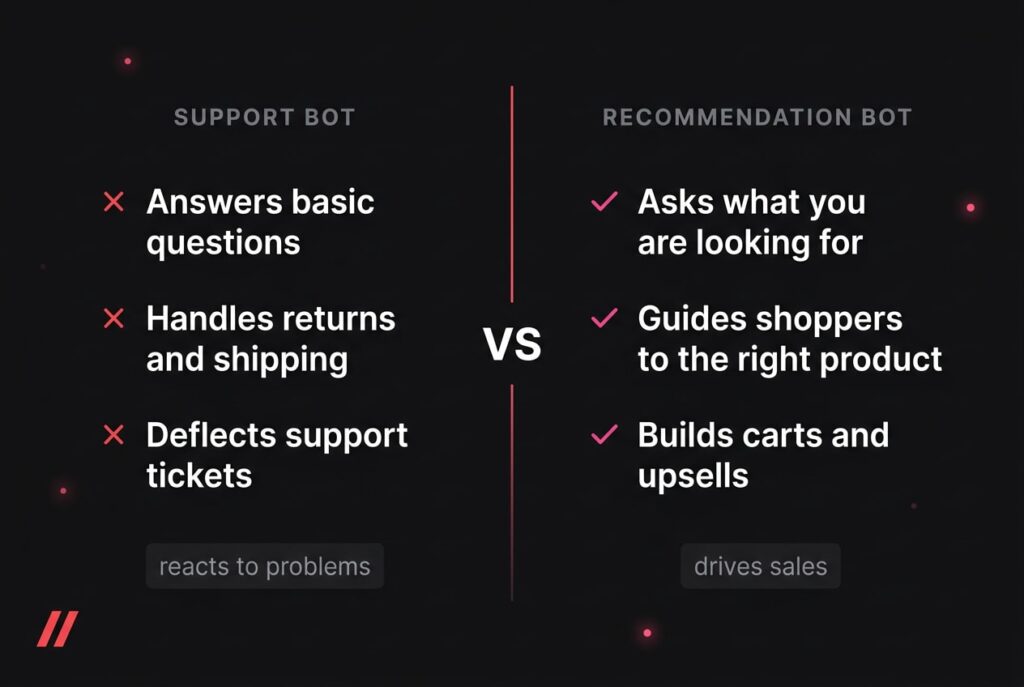
Best chatbot for ecommerce product recommendation
TL;DR
Most ecommerce chatbots are built for support deflection, not guided selling. The article evaluates Tidio, Gorgias, Intercom and others against product recommendation criteria including qualifying question logic, catalogue training depth, margin-aware prioritisation and ongoing AI management, noting where each platform has strengths and structural limitations.
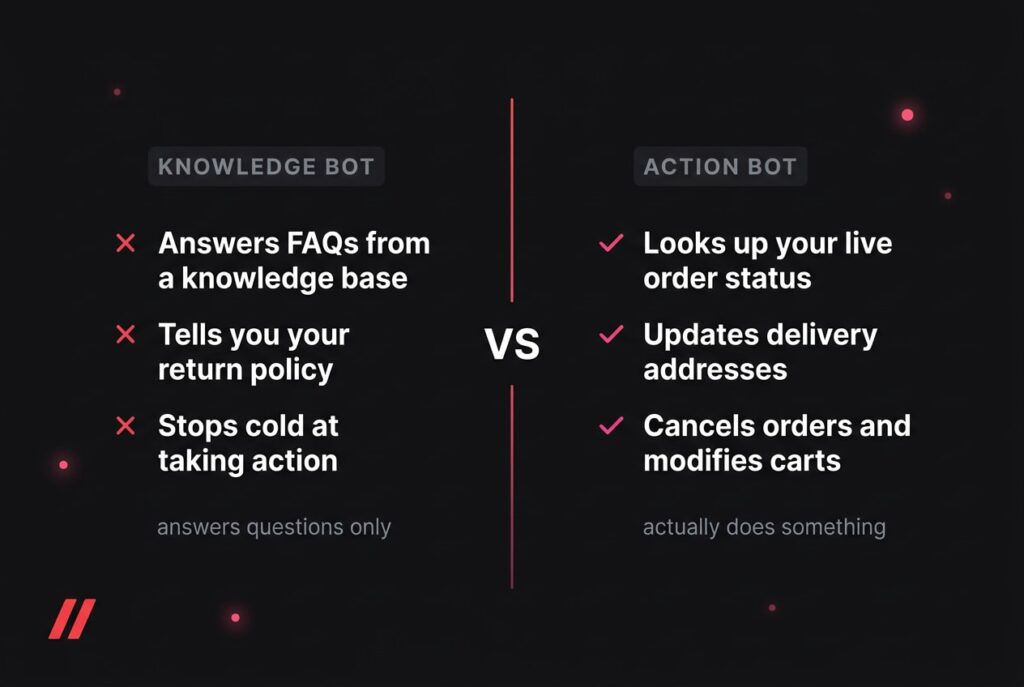
Best chatbot for order tracking and cart support
TL;DR
The article distinguishes between knowledge bots (FAQ-style answers) and action bots (live order lookups, address changes, cancellations) and argues most platforms only deliver the former. It benchmarks Gorgias, Tidio, Intercom and specialist tools against criteria including real-time data integration, ERP and logistics connectivity and human handoff quality.
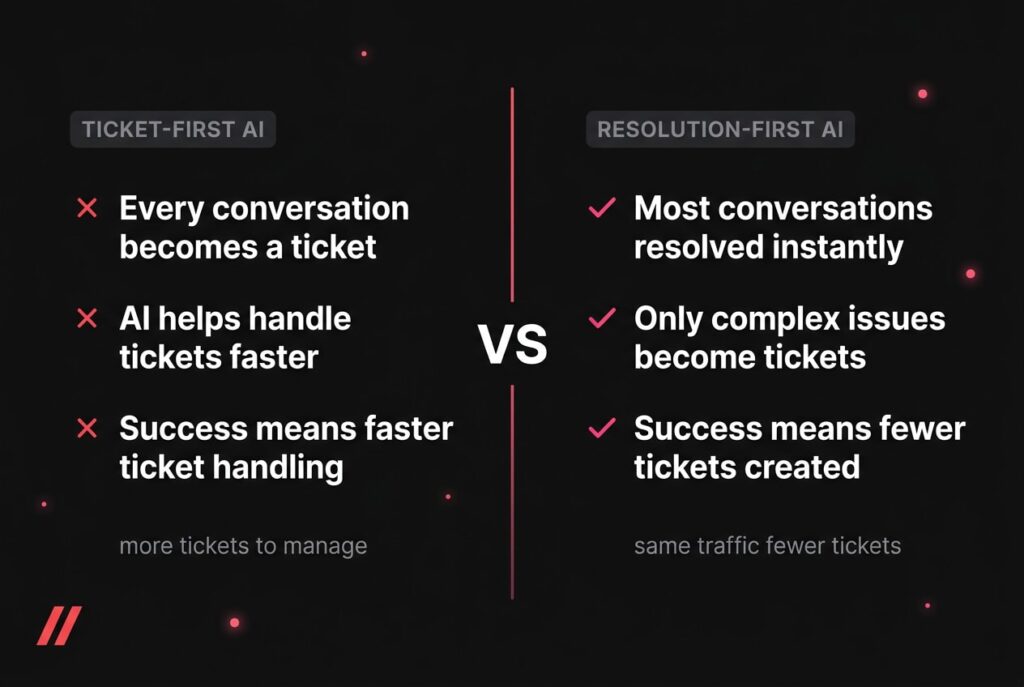
How we cut live-agent tickets by up to 82% for ecommerce brands still using Gorgias
TL;DR
Two ecommerce brands reduced live-agent tickets by 71-82% by adding a resolution-first AI chatbot in front of their existing Gorgias helpdesk. The article contrasts ticket-centric AI (faster handling) with resolution-first AI (fewer tickets created), covers Gorgias AI’s 2024 vs 2026 capabilities and presents real before-and-after data from both implementations.
9 reasons customers hate your AI chatbot
TL;DR
The article identifies nine common AI chatbot failure modes – including deflection over resolution, inability to reach a human, hallucinations, looping and poor handoff – backed by CX research from Forrester, Verint and PwC. Each failure mode is explained with data and paired with a contrasting implementation approach that addresses it.
Hack Your Workflow: With These AI Productivity Game Changers

Hello, Chatbots! Remember when Siri was introduced back in 2011? An AI voice assistant that could understand and process human speech, Siri marked a significant advance in conversational artificial intelligence. But fast forward to 2024, and what once seemed revolutionary now feels rudimentary.Siri wasn’t strictly a chatbot, and her limitations were significant. But she was […]