

Want to know how well an intelligent AI Chatbot can represent your brand? We can create a free demo chatbot for you, no strings attached

Request Free Demo

Chatbots

Best chatbot for ecommerce product recommendation

Written by Tala Chisholm
Updated May 13, 2026

Free Chatbot Demo

Want to know how well an intelligent AI Chatbot can represent your brand? We can create a free demo chatbot for you, no strings attached.
TL;DR
Most ecommerce chatbots are built for support deflection, not guided selling. The article evaluates Tidio, Gorgias, Intercom and others against product recommendation criteria including qualifying question logic, catalogue training depth, margin-aware prioritisation and ongoing AI management, noting where each platform has strengths and structural limitations.
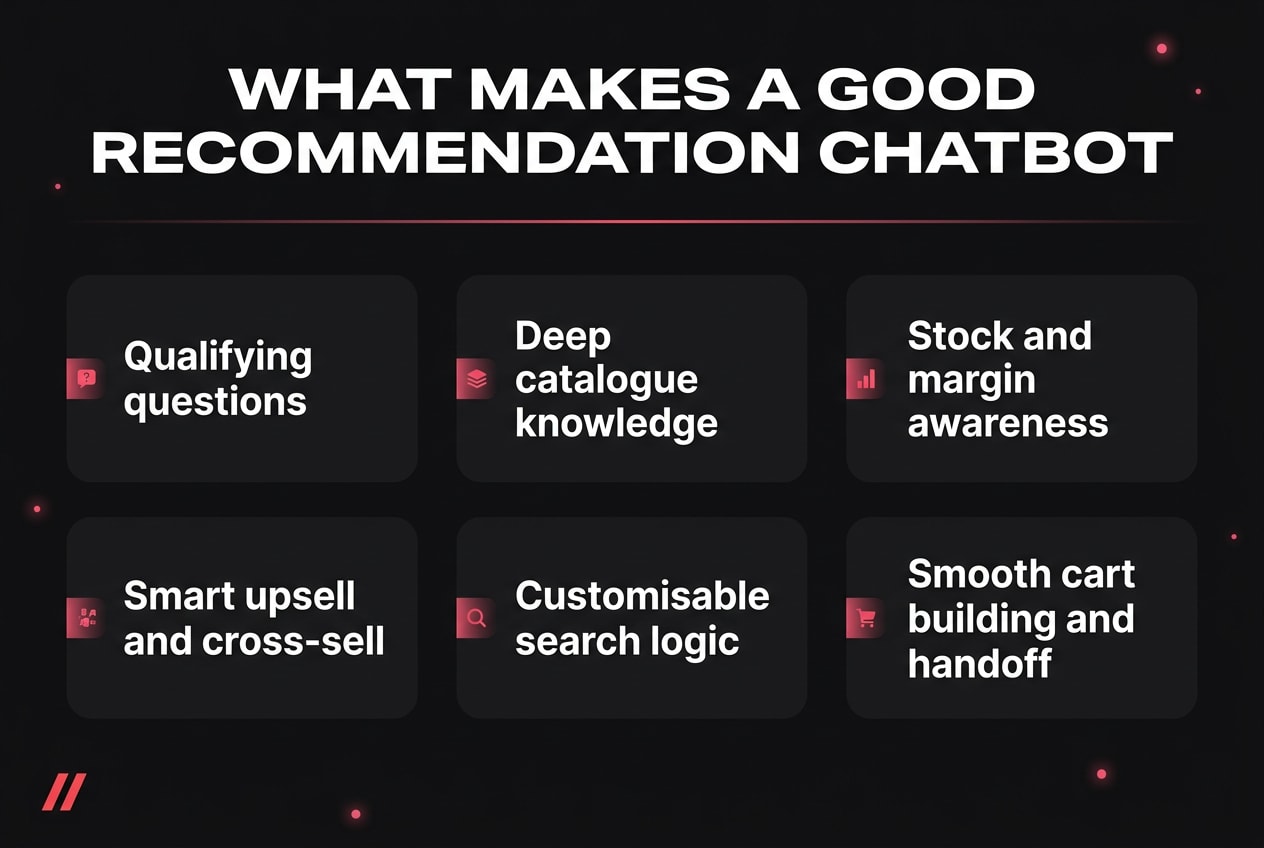
Table of Contents

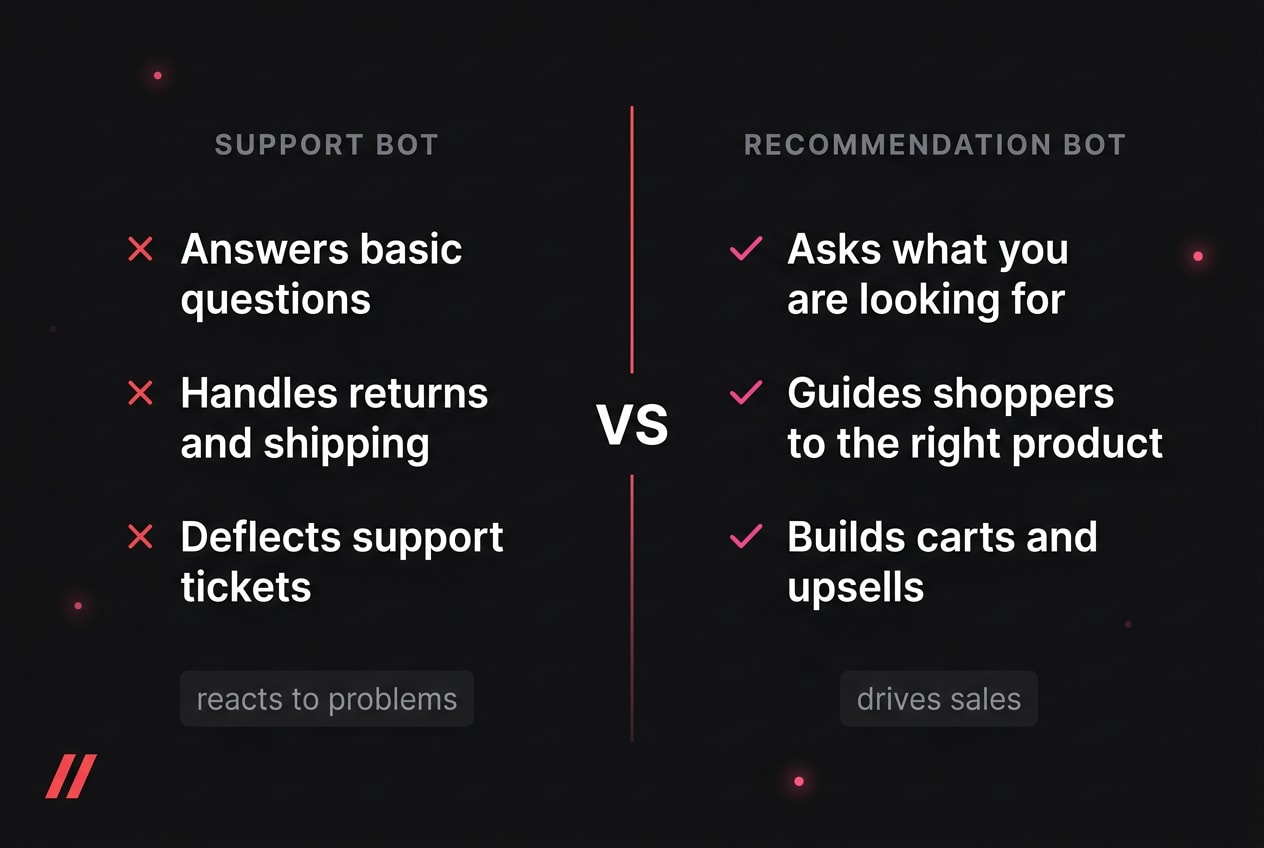
Most AI chatbots can field a question. Very few can actually guide a shopper to the right product, respect your stock and margin reality and help them build a cart in the same conversation. This article explains what separates a genuine product recommendation chatbot from a generic support bot, compares the leading platforms against criteria that actually matter and shows where Pivot Point fits in for stores that want more than a polished FAQ deflection tool.

TL;DR

Most ecommerce chatbots are built for support deflection, not guided selling. The article evaluates Tidio, Gorgias, Intercom and others against product recommendation criteria including qualifying question logic, catalogue training depth, margin-aware prioritisation and ongoing AI management, noting where each platform has strengths and structural limitations.

chatbot-best-for-ecom-recommendations_2_replacement

1. Why product recommendation chatbots matter

Shoppers who engage with personalised product recommendations convert more, spend more and return more often. The gap between assisted and unassisted sessions is large enough that for most ecommerce stores, recommendation quality is one of the highest-leverage areas to improve.

Product recommendations account for just 7% of ecommerce traffic but generate 24% of orders and 26% of revenue.  (Barilliance)

Sessions where shoppers engage with a single recommendation show a 369% increase in average order value compared to sessions with no recommendation engagement.  (Barilliance)

Personalised product recommendations can increase conversion rates by up to 26%.  (Barilliance / McKinsey)

49% of consumers have purchased items they did not initially plan to buy after seeing a personalised recommendation.  (Clerk.io / Involve.me)

91% of consumers are more likely to shop with brands that provide relevant offers and recommendations.  (Accenture)

The challenge is that most AI chatbots were not built with this outcome in mind. They were designed to deflect support tickets. Answering ‘Where is my order?’ is a fundamentally different problem from guiding a shopper through a considered purchase. The two require different architecture, different training depth and different ongoing management.
A genuinely useful product recommendation chatbot needs to understand your catalogue deeply, ask intelligent qualifying questions, surface the right SKUs at the right moment and respect the commercial logic of your business – which products you want to prioritise, which are out of stock and which combinations unlock the highest value for both customer and store.

2. What to look for in a product recommendation chatbot

Before comparing specific tools, it helps to establish what good actually looks like. These criteria separate tools that genuinely drive conversions from tools that answer questions.

Ability to ask qualifying questions

A product recommendation conversation should begin with the bot gathering intent, not launching into a generic top-sellers list. That means asking about use case, budget, compatibility, fit, or any other dimension relevant to your specific catalogue. Critically, those questions should also change depending on what the shopper is asking about — the qualifying logic for someone browsing running shoes is different from someone asking about supplements, power tools, or outdoor furniture. A bot that asks the same fixed set of questions regardless of product context quickly feels robotic and irrelevant. Generic bots tend to skip qualifying questions entirely and return keyword-matched results instead; the better ones ask questions, but still apply a one-size-fits-all flow that does not adapt to the product category in front of it.

Training depth on your catalogue

The quality of recommendations is directly proportional to training depth. A bot that has only scanned product page titles will give shallow answers. A bot trained on product attributes, compatibility matrices, care instructions, customer FAQs and internal documentation will give expert-level answers. There is a significant practical difference between those two outcomes.

Control over prioritisation

Your business has priorities that no generic algorithm knows about. High-margin lines. Products you are overstocked on. Strategic ranges you are pushing this quarter. A recommendation engine that operates purely on relevance or ‘people also bought’ logic has no way of factoring those in. The best tools give you explicit control over which products get surfaced first and why.

Cross-sell and upsell logic built around your catalogue

Upselling the more expensive version and cross-selling the complementary accessory are distinct strategies. Both require catalogue-specific rules. A bot that recommends a camera bag to someone asking about DSLR lenses is doing its job. A bot that recommends a phone case to someone buying a laptop is not.

Multi-channel coverage and smooth human handoff

Shoppers research across channels. A recommendation conversation that starts on your website might continue via WhatsApp or social DM. And some high-value purchase decisions benefit from a human touch. The best tools support these transitions without the customer having to repeat themselves.

Managed AI training and ongoing tuning

Catalogues change. Language evolves. Recommendations that worked in January need reviewing in July. A self-serve chatbot that only improves when the merchant logs in to make manual adjustments will gradually degrade. Platforms that include managed AI support keep recommendation quality sharp without requiring internal technical resources.

3. How leading tools compare

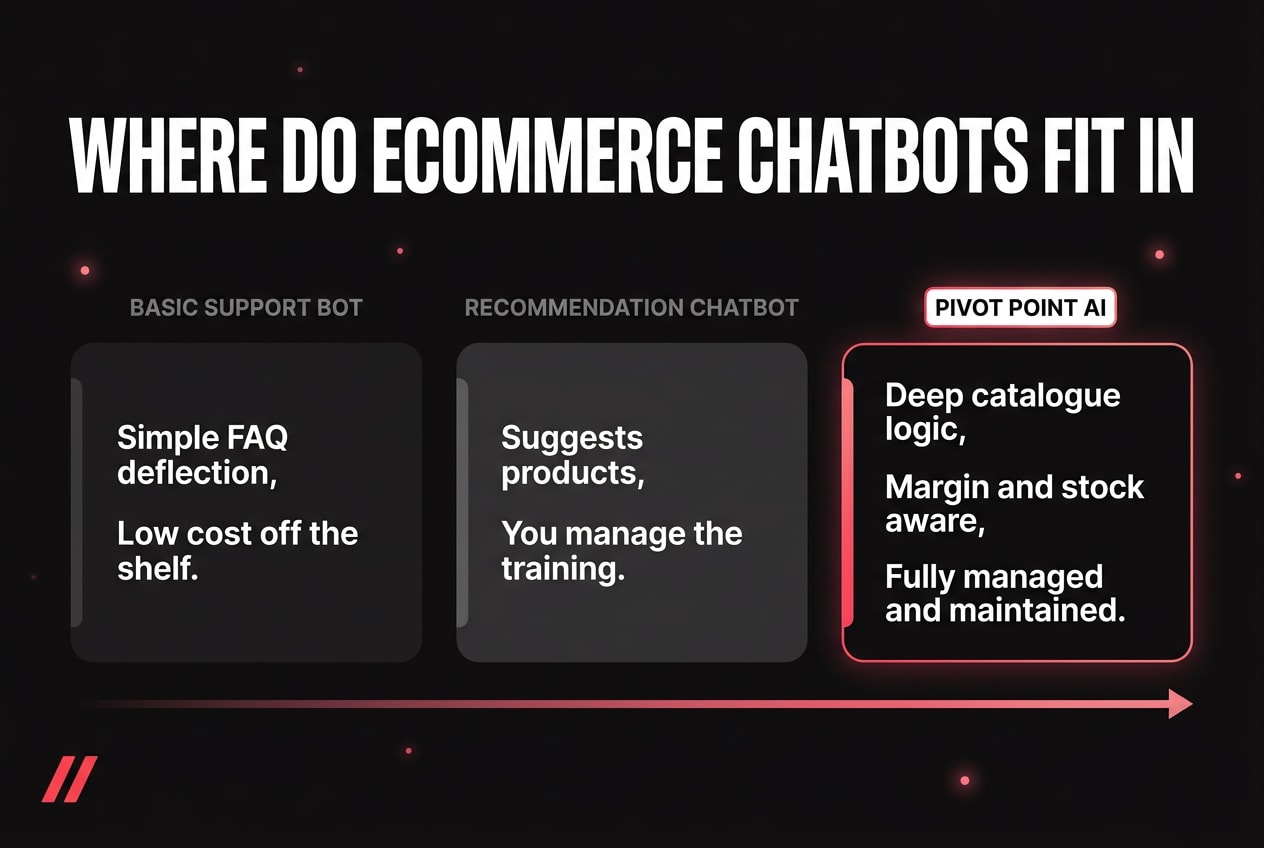
The table below maps the most commonly evaluated AI chatbot platforms against those criteria. All information is drawn from each platform’s published documentation and feature guides as of 2026.
Criteria Pivot Point AI Tidio (Lyro) Gorgias AI Shopping Assistant Intercom Fin Tolstoy / Others
Qualifying questions Custom flows designed for your specific catalogue Keyword-triggered flows; limited pre-purchase logic Behaviour-inferred from catalogue and page data; not conversational qualification Bot recipe available; labelled 'high setup effort' in official guides Varies - mostly visual/video-based discovery
Catalogue training depth Website + ERP, Google Drive docs, keyword equivalents, structured attributes. Knowledge base starting at 5,000 pages Shopify product sync via API; knowledge base capped at 60 pages Shopify catalogue, inventory, policies and brand voice - Shopify-native depth Help-centre and documentation RAG; ecommerce product logic needs additional work Typically product page text and catalogue feed only
Stock and margin awareness Configurable priority rules - high-margin, in-stock, strategic lines first None - no margin or stock-priority rules Real-time inventory from Shopify; no explicit margin-priority control None out of the box None
Upsell / cross-sell logic Catalogue-specific rules set by Pivot Point team Generic complementary product suggestions via Shopify sync Complementary items and in-stock alternatives from live catalogue; support-led Campaign-based; not product-catalogue-specific without custom config Limited or requires manual flows
Cart building in chat Full cart assembly within conversation Order management actions available; cart-add depends on setup Direct add-to-cart from chat; returns and order management included Not natively ecommerce-specific Varies
Platform support Shopify, WooCommerce, BigCommerce, Wix, Neto, OpenCart Shopify, WooCommerce (primary) Shopify, BigCommerce, Magento only Platform-agnostic via API; not ecommerce-native Mostly Shopify / social channels
Ongoing AI management Fully managed - training, tuning, fixes all handled by Pivot Point Self-managed by merchant Self-managed - merchant configures and maintains Self-managed; high configuration effort per official documentation Self-managed
Best positioned for Ecommerce stores needing guided, margin-aware, deeply trained product recommendation Small-to-mid Shopify stores wanting affordable AI support with basic product suggestions Shopify-first DTC brands wanting ecommerce-native AI within a helpdesk ecosystem SaaS and enterprise CX teams with resources to build and maintain custom product-rec workflows Visual-first or social-commerce discovery experiences
Criteria Pivot Point AI Tidio (Lyro) Gorgias AI Shopping Assistant Intercom Fin Tolstoy / Others
Qualifying questions Custom flows designed for your specific catalogue Keyword-triggered flows; limited pre-purchase logic Behaviour-inferred from catalogue and page data; not conversational qualification Bot recipe available; labelled ‘high setup effort’ in official guides Varies – mostly visual/video-based discovery
Catalogue training depth Website + ERP, Google Drive docs, keyword equivalents, structured attributes. Knowledge base starting at 5,000 pages Shopify product sync via API; knowledge base capped at 60 pages Shopify catalogue, inventory, policies and brand voice – Shopify-native depth Help-centre and documentation RAG; ecommerce product logic needs additional work Typically product page text and catalogue feed only
Stock and margin awareness Configurable priority rules – high-margin, in-stock, strategic lines first None – no margin or stock-priority rules Real-time inventory from Shopify; no explicit margin-priority control None out of the box None
Upsell / cross-sell logic Catalogue-specific rules set by Pivot Point team Generic complementary product suggestions via Shopify sync Complementary items and in-stock alternatives from live catalogue; support-led Campaign-based; not product-catalogue-specific without custom config Limited or requires manual flows
Cart building in chat Full cart assembly within conversation Order management actions available; cart-add depends on setup Direct add-to-cart from chat; returns and order management included Not natively ecommerce-specific Varies
Platform support Shopify, WooCommerce, BigCommerce, Wix, Neto, OpenCart Shopify, WooCommerce (primary) Shopify, BigCommerce, Magento only Platform-agnostic via API; not ecommerce-native Mostly Shopify / social channels
Ongoing AI management Fully managed – training, tuning, fixes all handled by Pivot Point Self-managed by merchant Self-managed – merchant configures and maintains Self-managed; high configuration effort per official documentation Self-managed
Best positioned for Ecommerce stores needing guided, margin-aware, deeply trained product recommendation Small-to-mid Shopify stores wanting affordable AI support with basic product suggestions Shopify-first DTC brands wanting ecommerce-native AI within a helpdesk ecosystem SaaS and enterprise CX teams with resources to build and maintain custom product-rec workflows Visual-first or social-commerce discovery experiences

A note on each platform

Tidio (Lyro)  Lyro AI supports product recommendations via Shopify product sync and API, handling variant suggestions and complementary product discovery in real time. It is widely positioned as the best low-cost starter for small-to-mid Shopify stores. Its practical ceiling is a 60-page knowledge base limit and a primarily support-oriented design – deeper logic such as margin-first prioritisation or ERP-level constraints requires more advanced tooling.
Gorgias AI Shopping Assistant  Gorgias has built a genuinely ecommerce-focused recommendation product. It pulls live data directly from the Shopify product catalogue, analyses customer behaviour and browsing context in real time and can recommend complementary items, in-stock alternatives and dynamic discounts within chat. It also handles order management and returns. Its main constraint is ecosystem lock-in: the Shopping Assistant lives inside the Gorgias helpdesk, so you are adopting Gorgias as your support platform, not just a recommendation add-on. Explicit merchant-defined prioritisation rules – such as margin-first ordering or complex business logic – are not a documented feature.

Intercom Fin  Intercom does offer a ‘Product Recommendation bot’ recipe that can ask qualifying questions and surface products based on answers. With a carefully curated knowledge base and Fin’s RAG capability, you can build a functional product-consultant bot. Intercom’s own documentation and third-party implementation guides explicitly describe this as a ‘high setup effort’ use case, however. Out of the box, Fin is trained on help-centre and documentation content; reaching ecommerce-grade product logic – catalogue awareness, margin and stock rules, dynamic bundles – requires additional implementation work and structured content. Intercom is not ecommerce-specific.

Tolstoy, Boei and others  These tools bring video-based and widget-based product discovery that works well for visual categories. They are strong for specific use cases – shoppable video, social commerce, visual try-on – but lack the catalogue depth, rule management and ongoing AI training support of a managed service.

Want to see how Pivot Point handles this for your catalogue?

We’ll walk through a demo scoped to your product range and platform.
Book a call

4. Where these tools fall short for deeper product logic

The limitations of generic chatbots in a product recommendation context cluster around the same four pain points regardless of platform.

Limited control over which products get recommended

Most platforms surface products based on semantic relevance or ‘people also bought’ patterns from aggregate purchase data. That is a useful baseline, but it ignores your specific commercial priorities. If you have overstocked a particular line, recently launched a range you want to push or have one SKU with significantly better margin than a comparable alternative, none of that context reaches a generic recommendation engine. The result is technically relevant suggestions that are commercially suboptimal.
Gorgias comes closest to addressing this – its Shopping Assistant uses real-time inventory data and can surface in-stock alternatives – but explicit merchant-defined margin rules and strategic prioritisation are not a documented capability. Tidio and Intercom do not offer this at all without custom development.

Thin training options

The majority of ecommerce chatbots are trained by crawling your website. If your product descriptions are short or SEO-focused rather than written for shoppers, the bot reflects that. It will not know what a good in-store sales assistant would know: which products pair well, what common misconceptions customers have, which sizes run small, which variants are discontinued. Filling those gaps requires structured training beyond a web crawl – and that is true even of Gorgias, whose catalogue training is excellent within the Shopify data model but does not extend to ERP data, internal documents or knowledge held outside the platform.

Recommendations that ignore stock, margin and business logic

A recommendation that sends a shopper to an out-of-stock product is worse than no recommendation at all. A recommendation that consistently surfaces low-margin products ahead of higher-margin alternatives is actively costing the business money. Only platforms with real-time inventory access and merchant-defined prioritisation rules can avoid this. Of the tools covered here, Gorgias has real-time Shopify stock visibility, but none offer explicit margin-aware prioritisation logic configurable by the merchant.

No ongoing improvement without merchant input
AI chatbots are not static. Recommendations that worked last quarter may be less relevant today. New products launch, old products are discontinued and customer language evolves. Self-serve platforms improve only when the merchant actively updates training material, adjusts flows or reviews conversation logs for gaps. Most merchants do not have the time or technical confidence to do this consistently – which means most chatbots gradually become less effective the longer they run without dedicated oversight.
chatbot-best-for-ecom-recommendations_3_replacement

5. How Pivot Point AI handles ecommerce product recommendation

Pivot Point was built specifically around the problem of guided, catalogue-aware, commercially intelligent product recommendation. Every element of the service is designed to address the limitations above.

Qualifying question flows designed for your catalogue

We design the qualifying question logic specifically for your product range – and crucially, the questions adapt dynamically based on what the shopper is asking about. A customer asking about a running shoe gets asked about surface, distance, and cushion preference. A customer asking about a pool pump gets asked about pool size, flow rate requirements and whether they are replacing an existing unit. The questions are not a fixed script applied to every enquiry – they reflect the actual decision dimensions that matter for the specific product category in front of the shopper at that moment. This is what makes the recommendations feel like expert guidance rather than a filtered search result.

Deep training beyond the website

We train the AI on website content, but we go further. Product attribute data, compatibility rules, internal buying guides, staff knowledge documents and Google Drive content can all be fed into the knowledge base. We also add keyword equivalents – so if your customers say ‘bearings’ and your product data says ‘ball bearing assemblies’, the bot understands both. This depth of training is what allows confident, specific answers that actually drive purchase decisions.

Configurable product prioritisation

Pivot Point gives you control over which products the AI surfaces first. You can instruct the bot to prioritise in-stock items, high-margin SKUs over comparable lower-margin alternatives, new arrivals over clearance lines or strategic ranges over legacy catalogue. This logic sits in the training layer and is maintained as part of your ongoing managed service – you do not need to log in and update rules manually when something changes.

Cart-building within the conversation

Rather than pointing shoppers to a product page and hoping they convert, Pivot Point’s recommendation flows can walk a shopper through assembling a complete cart within the chat. The bot can recommend a primary product, surface a complementary accessory and help the shopper add everything directly. This is particularly effective for considered purchases where the shopper needs confidence before committing.

Fully managed - no internal specialists required

The entire AI training and tuning process is managed by our team. When the bot gives a wrong answer, we fix it. When your recommendation rules change, we update the training. When review of conversation logs surfaces a gap, we address it in the next tuning cycle. You do not need an internal AI specialist to maintain recommendation quality over time.

6. Example flows

The following examples illustrate what a well-configured product recommendation conversation looks like in practice.

Example 1 - Running shoe recommendation (footwear store)

Shopper:  I need a running shoe for daily commuting in hot weather.

Bot:  Happy to help you find the right one. A couple of quick questions first – are you mainly running on roads and footpaths or do you mix in gravel or trail sections?

Shopper:  Roads mostly, sometimes light gravel.

Bot:  Got it. And roughly what distance are you covering each day – under 5km, 5–10km or more?

Shopper:  Usually 6–8km.

Bot:  Based on that, the Asics Gel-Nimbus 26 is a strong fit – it’s built for road use with a breathable mesh upper for heat and has enough cushion for your distance. The Brooks Ghost 16 is a touch lighter if you prefer a less padded feel. Both are in stock. Would you like to compare sizing options or add one to your cart?

Example 2 - Accessories cross-sell from a product page (consumer electronics store)

Shopper:  [Viewing Sony WH-1000XM5 headphone product page]

Shopper:  What goes well with this?

Bot:  Great choice – the XM5 is one of our most popular noise-cancelling headphones. A few things pair really well with it. The Sony WLA-NS7 wireless adapter lets you use them with TVs and consoles that don’t have Bluetooth. The hard-shell carry case protects them during travel if you prefer more protection than the included soft pouch. And the Anker USB-C audio adapter is a handy pickup for desktop use. Would you like to add any of those to your cart?

In both examples the bot demonstrates catalogue knowledge beyond what is visible on a product page and offers to progress the shopper directly toward a cart rather than redirecting them to browse independently.

7. Choosing the right tool for your store

The honest summary is this. If your primary need is deflecting a chunk of support tickets and handling post-purchase queries on a Shopify store, Gorgias or Tidio will likely serve you well at a reasonable cost. Gorgias in particular has built a genuinely ecommerce-focused shopping assistant that earns its place in that category.
The difference is not just a feature checklist. It is about whether the AI has been trained deeply enough on your specific products and commercial logic to give the kind of answer that actually moves a shopper from browsing to buying. That training requires expertise and ongoing management, which is exactly what a self-serve platform cannot provide by definition.
Pivot Point is positioned specifically for ecommerce stores where the quality of product recommendation directly affects revenue. If that sounds like your situation, we would be happy to walk through what a recommendation-focused implementation looks like for your catalogue.

Ready to turn your chatbot into a sales asset?

We’ll scope a product recommendation implementation specific to your catalogue, platform and commercial priorities. No lock-in, monthly agreements.
Let’s create a demo for you

Free Chatbot Demo

Want to know how well an intelligent AI Chatbot can represent your brand? We can create a free demo chatbot for you, no strings attached

Keep reading

At Lightsounds (the professional audio and lighting business Rick and I built over nearly two decades,
At Lightsounds (the professional audio and lighting business my husband Rick and I built over nearly two decades,
I’m going to start this one differently than you might expect from someone who builds chatbots for a living.

Want to see what we'd build for your business?

Book a free demo and test a chatbot trained on your own website content, no obligation.