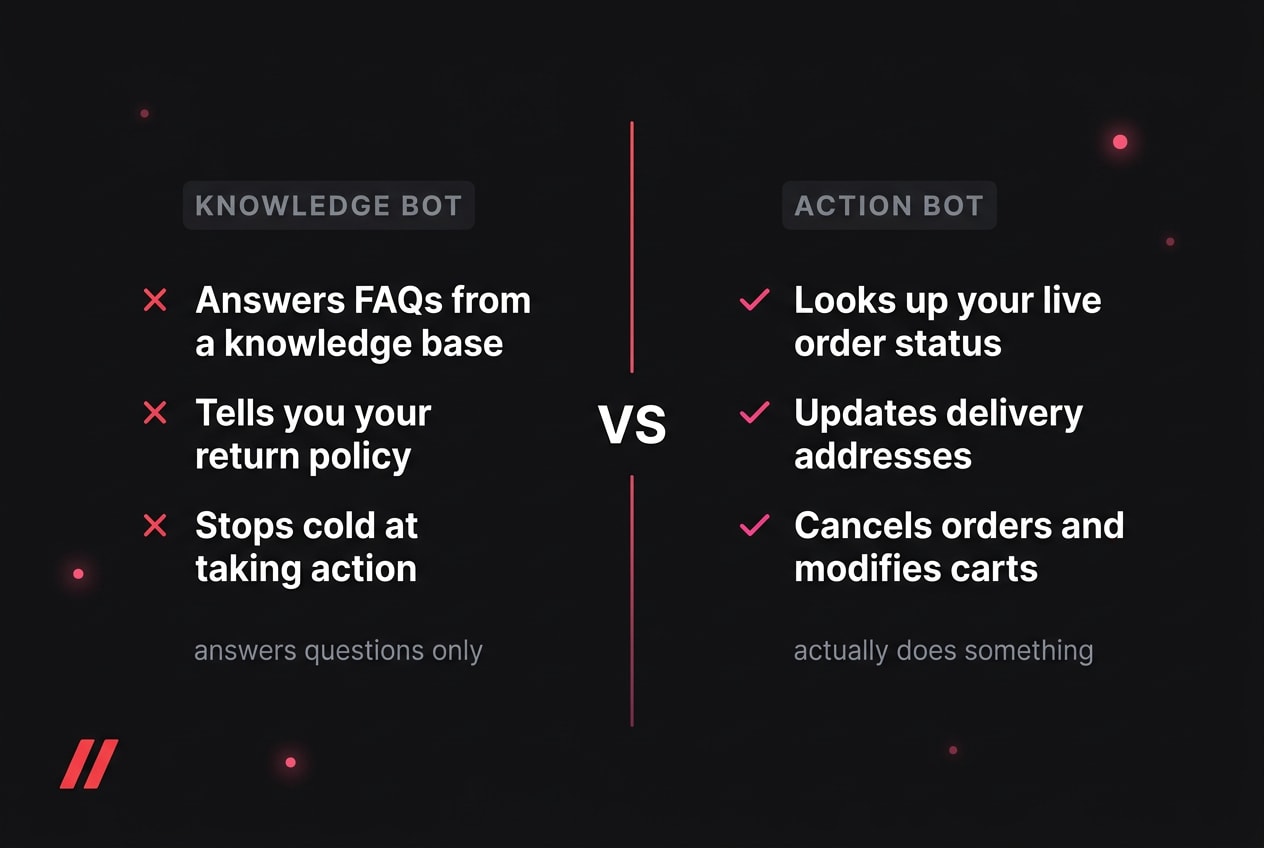
Most AI chatbots are knowledge bots. They are good at answering questions from a trained knowledge base: return policy, shipping timeframes, product specifications. But there is a hard boundary between answering a question and actually doing something. ‘What is your return policy?’ is a knowledge question. I’ve put the my old address on the order I just placed. Can you change the delivery address?’ is an action request – and most chatbots stop cold at that line. This article explains why that distinction matters, what to look for in a chatbot that can genuinely handle order and cart actions, how the leading platforms compare and where Pivot Point fits for ecommerce stores that want more than a sophisticated FAQ engine.
The article distinguishes between knowledge bots (FAQ-style answers) and action bots (live order lookups, address changes, cancellations) and argues most platforms only deliver the former. It benchmarks Gorgias, Tidio, Intercom and specialist tools against criteria including real-time data integration, ERP and logistics connectivity and human handoff quality.
1. Why order tracking and cart support are different from FAQs
There are two fundamentally different kinds of chatbot capability and the distinction is almost never made clearly enough in platform marketing.
A knowledge bot retrieves information from a trained knowledge base. It can tell a customer what your return window is, how international shipping works or what materials a product is made from. This is genuinely useful and a well-trained knowledge bot can handle a large share of pre-purchase queries with confidence.
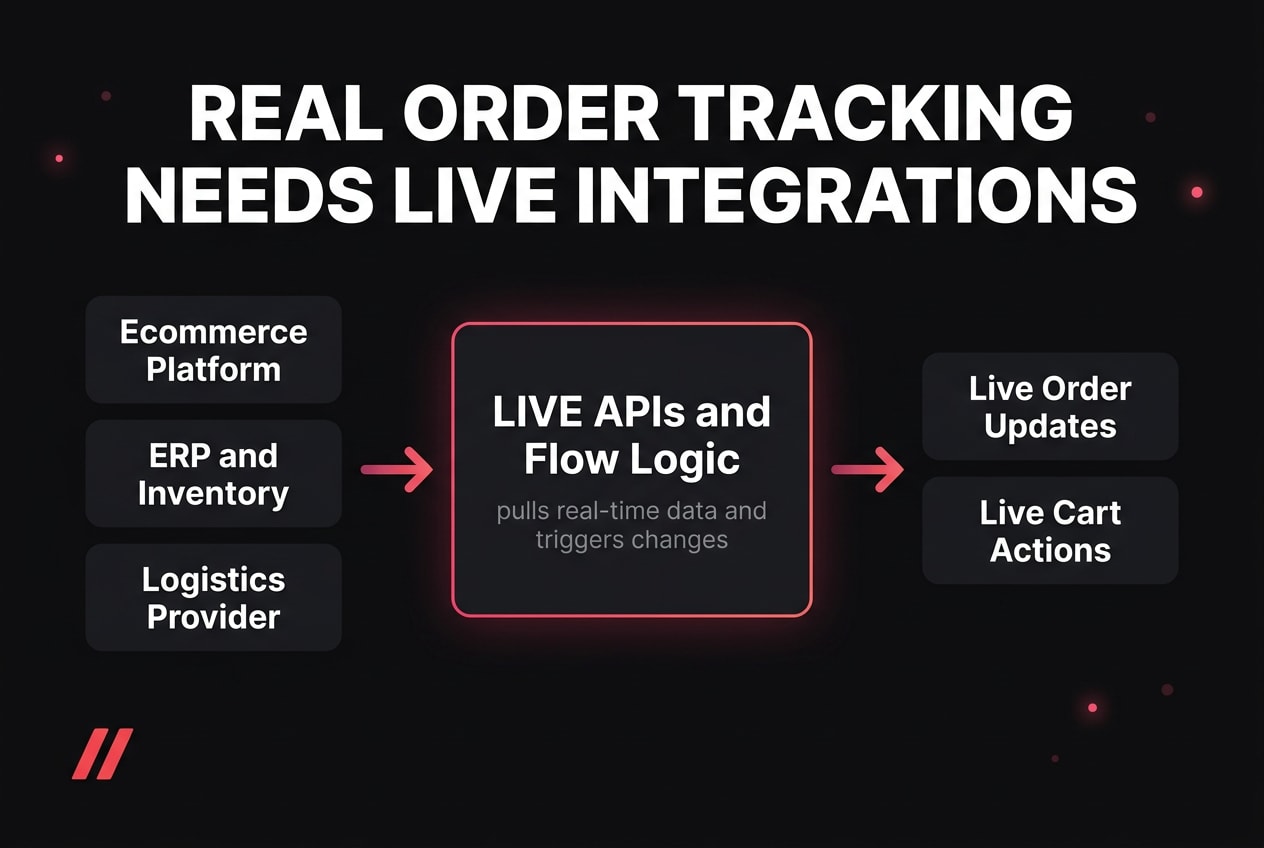
An action bot can actually do things. It can look up a specific order in a live system, confirm where it is in the fulfilment chain, trigger a shipping address change, initiate a cancellation request, check real-time stock query (e.g. in an ERP system) or add an item directly to a cart. These actions require live data connections to your ecommerce platform, your ERP and your logistics provider. They cannot be approximated by scraping your website.
The gap between these two categories is where most customer frustration in ecommerce support originates. Consider the difference in experience:
The knowledge bot is not wrong. It is simply not what the customer needs in that moment. And in ecommerce, where post-purchase anxiety is high and delivery expectations have been set by Amazon-level transparency, a bot that cannot act is a frustration engine.
WISMO (Where Is My Order?) queries account for 30–40% of all ecommerce support tickets during normal periods, rising to 50% or more during peak season. (LateShipment)
Industry CX benchmarks estimate that each support interaction costs 5–25 USD, depending on channel and complexity, which puts WISMO tickets in the same cost range (Industry benchmark cited by bind)
One survey found 96% of shoppers track their delivery status at least once and 43% track daily until their package arrives. (loopreturns)
85% of online shoppers say a poor delivery experience would stop them from ordering from that retailer again (ipsos)
The operational and loyalty implications are significant. Brands that cannot close the gap between ‘here is our policy’ and ‘here is what is happening with your specific order, right now’ are absorbing unnecessary cost, generating unnecessary frustration and quietly eroding the post-purchase relationship that determines repeat purchase rate.
2. What to look for in an order tracking and cart support chatbot
These are the criteria that separate a chatbot that genuinely handles order and cart actions from one that merely talks about them.
The chatbot must be able to retrieve live order data from your ecommerce platform or logistics provider at the moment a customer asks. Not cached data from a sync that ran two hours ago. Live data. This requires a genuine API connection to your order management system, not a knowledge base that has been trained on example order statuses.
Looking up an order is useful. Doing something about it is more useful. The best tools allow the chatbot to initiate cancellations, modify shipping addresses or raise change requests that route to the correct internal team – all within rules the business defines. For example: cancellations permitted within 24 hours of order placement, address changes permitted until the order is picked, returns initiated if within the returns window. The bot acts within those guardrails without requiring human intervention for routine cases.
Order data does not always live in one place. The ecommerce platform knows what was ordered. The ERP or inventory system knows whether it is actually in stock and at which warehouse. The logistics provider knows where the shipment is in transit. A chatbot that can only see one of those systems will give incomplete answers. The most capable implementations pull data from all three, so a customer asking about a delayed order gets an answer that reflects the real fulfilment situation, not just the platform’s last recorded status.
On the pre-purchase side, the chatbot can guide the customer through building their order within the conversation by helping them choose products, add items, suggest suitable alternatives where needed and then create a draft order for the customer to continue with. This goes beyond standard product recommendation because the chatbot is actively helping structure the purchase journey and preparing the order for checkout through a live connection to your store’s product, inventory and draft order systems.
Not every issue can be resolved by a bot. Complex disputes, emotionally charged complaints, edge cases outside the defined rules – these need a human. The critical requirement is that when the bot hands off, the full conversation context travels with it. The customer should never have to explain their situation again from scratch. This seems obvious, but it is one of the most commonly cited failures in ecommerce chatbot deployments.
3. How popular tools handle order tracking today
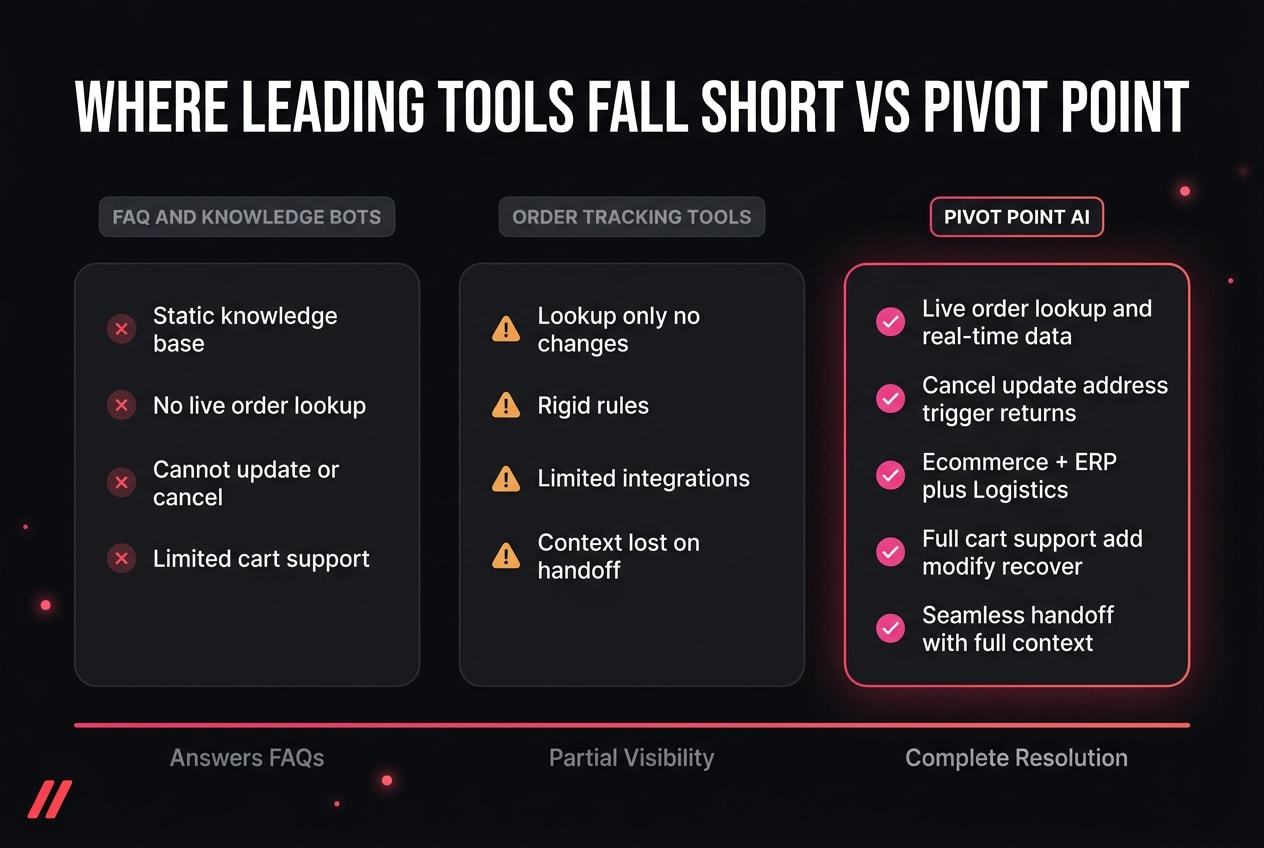
The table below maps the leading platforms against those criteria, based on publicly available documentation and platform feature guides as of 2026.
Gorgias Gorgias has the deepest native Shopify order management capability of most helpdesk platform. Agents can view order data, cancel orders, issue refunds, edit shipping addresses and insert product links directly from the Gorgias interface without switching to the Shopify admin. Self-service order tracking via a customer portal is also available, with rules governing what customers can do themselves. It is genuinely strong for Shopify-first stores. The important caveats are that Gorgias is a full helpdesk adoption, not a standalone chatbot or a modular capability you can drop into an existing stack. Its order management is ticket-centric by design. And its platform coverage is limited: Shopify, BigCommerce and Magento. WooCommerce is not natively supported. There is no ERP integration and logistics provider data does not feed directly into order responses.
Gorgias is not the only model for combining automation, operational actions and human handover. Pivot Point Helpdesk is designed to support these same kinds of service flows in a more modular way, allowing AI-led conversations, action-based support and escalation to a human agent without forcing a business to adopt Gorgias as its helpdesk stack. However, Pivot Point can also integrate with various helpdesk by integrating the handover of escalation tickets. This achieves both objectives of maximising the number of enquiries resolved by the AI (we have observed a rise in the AI-resolved tickets by over 60% compared to Gorgias AI auto resolutions) where clients were previously using Gorgias only.
Tidio Tidio is the simplest entry point for a small Shopify store that wants automated responses to WISMO questions and basic order tracking. It can answer order status questions once connected to a platform and it is fast to set up. Its ceiling is lower than Gorgias for actual order actions – it responds about orders rather than taking action on them. Reviews consistently position it as ideal for getting started, less suited to complex or multi-system order workflows.
Intercom Intercom can automate order-related conversations and trigger workflows based on customer behaviour. With Shopify and helpdesk integrations, it can access order details and use macros for common WISMO questions. Getting advanced ecommerce support flows working – particularly anything involving direct order edits or cart-level actions – requires significant setup and technical effort. Intercom is not ecommerce-native. It is a general-purpose customer engagement platform that can be configured for ecommerce use, but that configuration is work the merchant or their development team must do.
Specialist tools (Eesel, Outvio and similar) A category of tools focused specifically on post-purchase and order tracking automation. These typically offer real-time backend integrations with Shopify and WooCommerce for self-service WISMO resolution and some support self-service address changes and cancellations. They define the baseline expectation for what ‘good’ looks like in this category: live order status without human intervention. Most are self-serve platforms that the merchant configures and maintains.
We’ll walk through a live order tracking and cart demo scoped to your stack – Shopify, WooCommerce or otherwise.
Book a call
4. Common gaps that frustrate customers and cost brands money
The same failure patterns appear across platform reviews, customer complaints and support team post-mortems regardless of which tool is in use. These are the gaps that generate the most friction.
The most common frustration in ecommerce chatbot deployments is the bot that responds to a specific question with a generic instruction. ‘Please check your order confirmation email for your tracking link.’ ‘You can contact our support team to request a change.’ ‘Our return policy can be found at this link.’ These responses are not wrong, but they are not helpful when the customer is already in a chat window asking for immediate assistance. They signal that the bot is a knowledge retrieval system, not an action system – and customers recognise the difference immediately.
When a bot cannot resolve an issue and escalates to a human agent, the quality of that transition matters enormously. In the majority of chatbot deployments, the handoff is clean from the bot’s perspective and deeply frustrating from the customer’s. The human agent receives a ticket with a description of the issue. The customer is asked to explain their situation again. If they have already spent five minutes in a chatbot conversation providing their order number, describing the problem and confirming their details, being asked to repeat all of that to a human agent is a compounding failure, not a resolution.
A customer asking ‘Is this available in my size?’ on a product page is asking a different question from the same words typed on a category page or a homepage. A customer asking ‘Where is my nearest store?’ in Melbourne needs a different answer from a customer asking the same question in Perth. Chatbots that lack page context and geolocation awareness treat every enquiry as if it arrived from a blank state, which produces generic answers where specific ones were possible.
When a customer adds an item to cart and then discovers it is out of stock – or when the chatbot recommends a product that is no longer available – the resolution matters. A bot without cart and inventory awareness simply has no answer. A bot with live inventory access can suggest the most relevant available alternative, flag when restock is expected or offer to notify the customer when the item returns. The difference between those two experiences is the difference between a lost sale and a retained one.
5. How Pivot Point approaches order tracking and cart support
Pivot Point is built around the principle that a chatbot that cannot take action is only half a solution. Every implementation is designed with live data connections, not knowledge-only training
We integrate with your ecommerce platform, your ERP or inventory system and your logistics provider to give the bot access to real-time order data from all three sources simultaneously. A customer asking about their order gets the actual current status from the actual current fulfilment chain – not a templated response drawn from a knowledge base. For stores using Starshipit, we pull live carrier tracking data directly, so shipping status and ETAs reflect what the carrier knows right now, not what the platform recorded at the time of dispatch.
The bot is not a free agent. Every action it can take – cancellations, address changes, substitution suggestions, cart modifications – is governed by rules the business defines. Cancellations within 24 hours only. Address changes before the order reaches the picking stage. Returns within the store’s returns window. These guardrails mean the bot can handle the vast majority of routine post-purchase requests autonomously, without requiring a human agent to approve every action, while staying inside the operational boundaries the store needs.
This is a meaningful differentiator from platform-native tools like Gorgias. Gorgias is excellent within the Shopify ecosystem. But for stores running SAP, Unleashed or another ERP alongside their ecommerce platform and for stores using logistics providers beyond the standard Shopify-native carriers, Gorgias has no answer. Pivot Point can integrate with ERP systems for live stock and fulfilment data and with logistics providers like Starshipit for carrier-level tracking. This means the bot’s answers reflect the full operational picture, not just what the shopping platform can see.
Gorgias requires Shopify, BigCommerce or Magento. Tidio is primarily Shopify and WooCommerce. Intercom requires significant custom development for any ecommerce-specific capability. Pivot Point works across Shopify, WooCommerce, BigCommerce, Wix, Neto and OpenCart and we have the flexibility to build to your specific situation. If your stack is different or your combination of platforms and systems is unusual, that is not a limitation – it is what we are designed for. We are not limited to the integrations listed on a features page.
With live inventory access, the bot can see what is in a customer’s current cart, identify out-of-stock items and suggest the most relevant available alternatives based on both availability and business priorities. If a customer is viewing a product that is out of stock, the bot does not dead-end on an apology – it offers the next best option from available inventory, following the same priority logic that governs product recommendations.
The bot knows what page the customer is currently viewing. That context shapes its responses. A customer on a product page asking ‘Does this come in blue?’ gets an answer about that specific product. A customer on the checkout page asking ‘What are my delivery options?’ gets answers relevant to their cart and location. Geolocation allows location-specific responses for store finder queries, local stock availability and regional shipping information – without the customer having to specify where they are.
When an issue is outside the bot’s rules or genuinely needs a human, the full conversation transcript is passed to your helpdesk automatically. Pivot Point can hand off to Gorgias, Podium, LiveChat or your own support system – whichever you use. The human agent opens the ticket and sees everything: what the customer said, what the bot did, what data was pulled, where the resolution stalled. The customer does not repeat themselves.
6. Why this matters for customer experience and cost
The business case for action-capable order and cart support is straightforward once the numbers are visible.
At $5 to $22 per WISMO ticket handled by a human agent, a store processing 1,000 orders per month and generating a 30% WISMO rate is looking at 300 tickets per month on that category alone. At a conservative $8 per ticket, that is $2,400 per month in support costs tied entirely to order status questions. A bot that resolves those autonomously at a fraction of the cost changes the economics materially – and frees the human support team for the complex issues that actually require their judgement.
Post-purchase experience is a primary driver of repeat purchase. A customer who had to chase their order status, got redirected to a tracking email they could not find and eventually reached a human agent who asked them to start over is not a customer who is likely to return. A customer who got an immediate, accurate answer and had their address changed in 30 seconds without needing to speak to anyone is. The difference between those two experiences is not a marginal one in terms of lifetime value.
Order tracking failures generate the majority of negative ecommerce reviews. ‘Had to email three times to find out where my order was.’ ‘The chatbot just kept sending me back to the tracking link.’ ‘Was told to contact support, then had to repeat everything.’ These reviews are public, permanent and read by prospective customers at the moment they are deciding whether to buy. Reducing the frequency of these experiences is both a cost reduction and a brand protection measure.
WISMO volume spikes to 50% or more of total support during peak seasons. A human support team cannot scale instantaneously to handle that. A bot that can resolve the majority of routine order queries without human intervention provides genuine operational resilience at precisely the moments when it is most needed.
7. Choosing the right fit for your store
If you are a Shopify-first brand whose primary need is empowering your human support agents to handle order issues faster, Gorgias is a strong choice. It gives agents exceptional native Shopify order management capability inside a helpdesk they will already be working in.
If you need a chatbot that can resolve order and cart queries autonomously – without requiring a human agent to take action, without being tied to a single platform and with live data from your ecommerce platform, your ERP and your logistics provider – that is a different requirement and needs a different approach.
The distinction matters particularly for stores running WooCommerce, Neto or a custom platform. For stores using logistics providers outside the Shopify carrier ecosystem. For stores where inventory and fulfilment data lives in an ERP that the shopping platform does not see. And for stores that have outgrown the Shopify ecosystem or that operate across multiple platforms or markets.
Pivot Point is built for that situation. We are not a pre-packaged integration for one platform. We build to your stack, your data sources, your rules and your customers’ actual journey. If order tracking and cart support are where your customers are frustrating and your support team is spending time, that is exactly the conversation we would like to have.
We’ll scope an order tracking and cart support implementation specific to your platform, logistics setup and fulfilment rules. No lock-in, monthly agreements.
Book a discovery call