

TL;DR
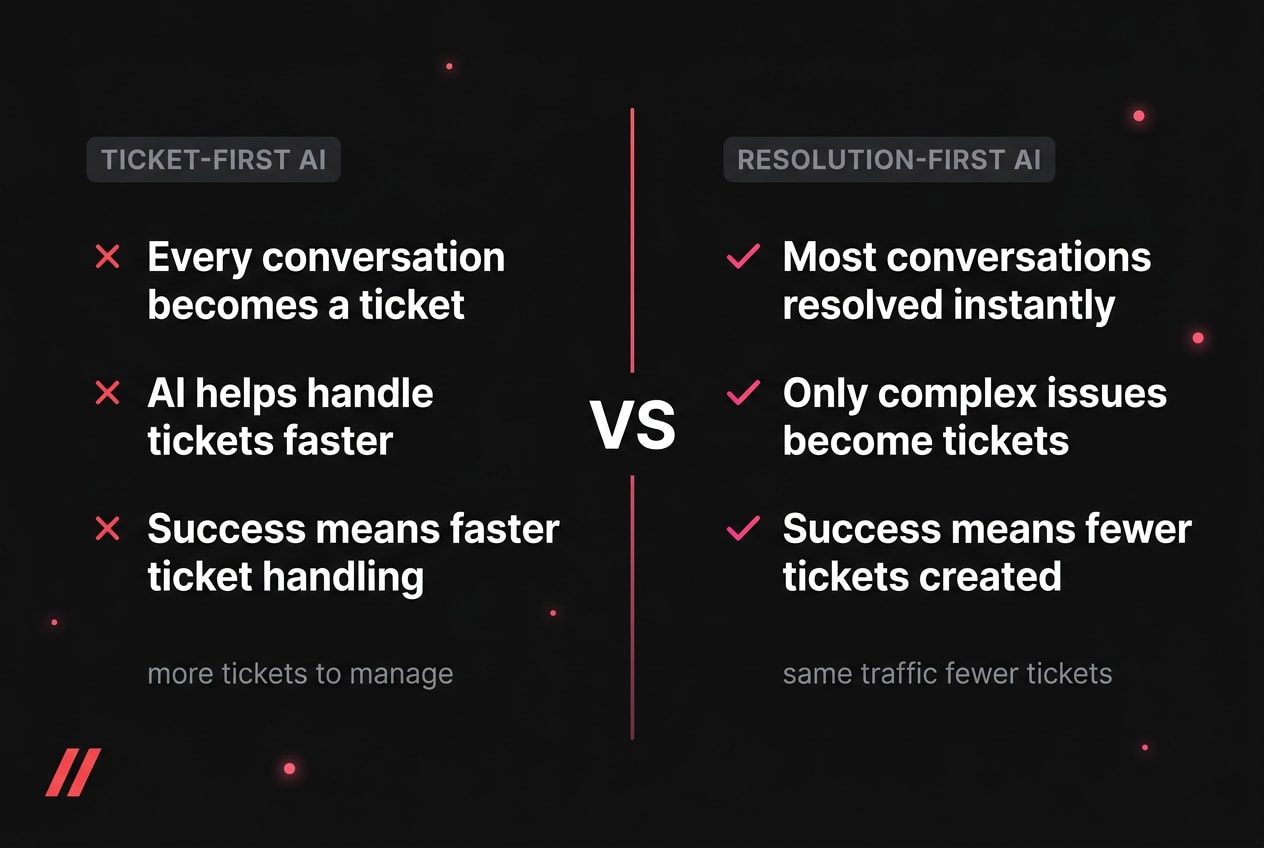
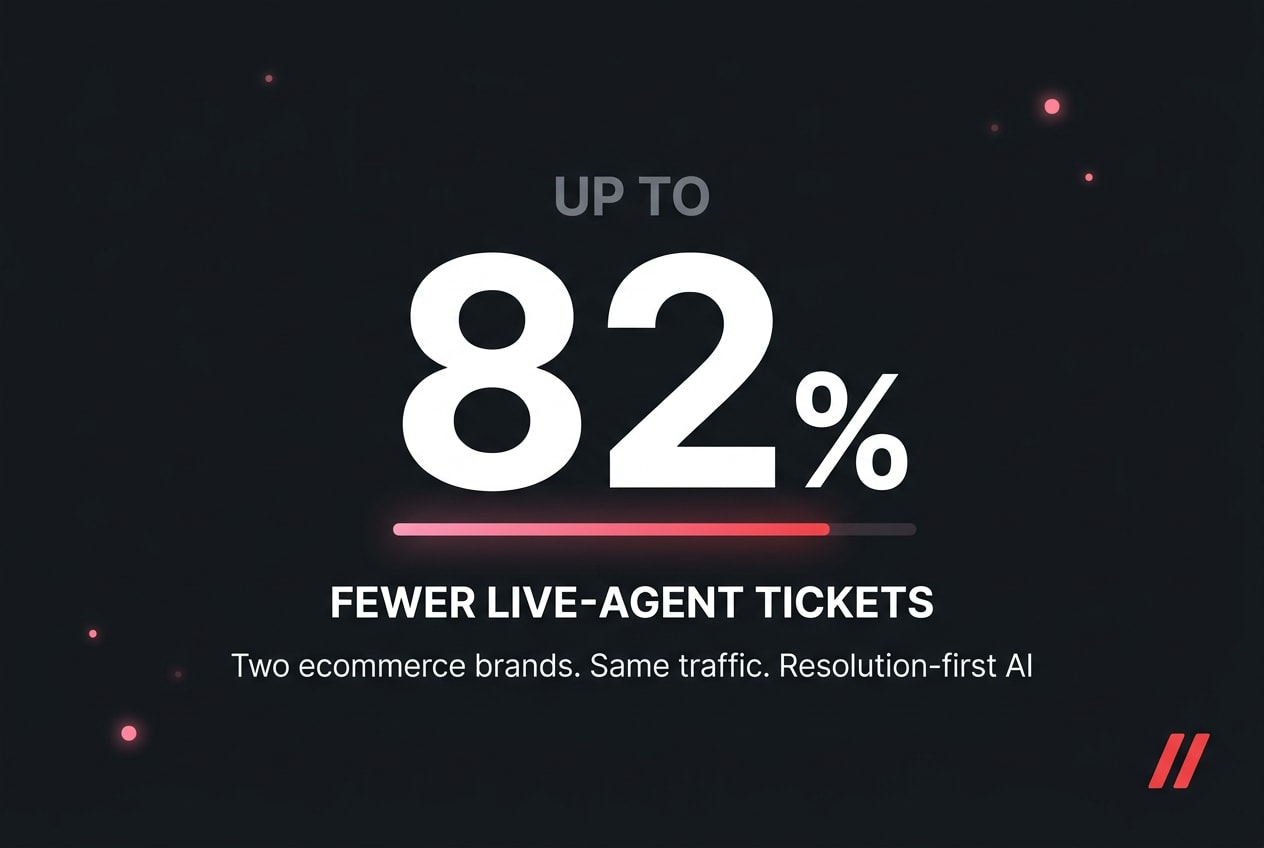
Two ecommerce brands reduced live-agent tickets by 71-82% by adding a resolution-first AI chatbot in front of their existing Gorgias helpdesk. The article contrasts ticket-centric AI (faster handling) with resolution-first AI (fewer tickets created), covers Gorgias AI’s 2024 vs 2026 capabilities and presents real before-and-after data from both implementations.
1. Why AI inside a helpdesk is not the same as AI in front of it
2. Ticket-first AI vs resolution-first AI
| Ticket-first AI (inside helpdesk) | Resolution-first AI (in front of helpdesk) |
|---|---|
| Conversation starts → ticket created → AI helps handle it | Conversation starts → AI resolves it → ticket only if escalation needed |
| AI reduces ticket handling time | AI reduces ticket volume |
| Metric: CSAT, response time, resolution rate per ticket | Metric: conversations per 1,000 sessions, tickets per 1,000 sessions |
| Works well when tickets are unavoidable | Works well when most conversations are answerable |
| Success = well-handled ticket | Success = conversation resolved before becoming a ticket |
3. A note on Gorgias AI: what it could do in 2024 and what it can do now
What Gorgias AI can do today (2026)
- Answer detailed product questions using catalogue data, product pages and custom product fields.
- Surface suggested product questions proactively above the chat widget, so shoppers get quick answers without searching.
- Recommend products based on cart contents, browsing behaviour and real-time Shopify inventory data.
- Handle WISMO queries with automated responses and self-service order tracking.
- Allow agents to cancel orders, issue refunds and edit shipping addresses directly from the Gorgias interface.
This is a material improvement on what existed in 2024 and it is worth acknowledging directly.
Where the limitations still are
That said, independent deep dives and user feedback consistently flag some constraints that remain as of 2026:
- Suggested product questions are largely autopilot – merchants cannot directly control which prompts appear. For stores with niche or complex catalogues, this can produce generic or unhelpful suggestions that do not reflect the most common or commercially important questions.
- The AI can still answer product questions overconfidently when the underlying content is incomplete or ambiguous. Independent reviews note cases of incorrect dimensions, wrong compatibility statements and inaccurate stock information when product data is sparse or inconsistent.
- Strong results depend on a well-maintained knowledge base and product catalogue. If information is scattered, missing or structured inconsistently, AI reliability degrades – and that maintenance is the merchant’s responsibility, not Gorgias’s.
- Platform coverage remains Shopify, BigCommerce and Magento. WooCommerce, Neto, Wix, Opencart are not supported. In addition, if the merchant is using an external logistics provider like Starshipit or Shipit, Gorgias has no access to those and therefore cannot answer tracking details that live in the logistics platforms.
| Capability | Gorgias AI (mid-2024, when case studies ran) | Gorgias AI (current, 2026) |
|---|---|---|
| Product Q&A | Not available. Agents handled all product questions manually. | AI Agent 2.0 and Shopping Assistant can answer detailed product questions using catalogue data, product pages and custom product fields. Suggested product questions surface proactively above the chat widget. |
| Product recommendations | Not available. No AI-driven product surfacing. | Shopping Assistant can recommend products based on cart contents, browsing behaviour and catalogue data, with real-time inventory awareness for Shopify stores. |
| Order support (WISMO) | AI-assisted ticket handling only. Agents handled all WISMO queries. Gorgias could handle some basic WISMO queries | Automated WISMO replies and self-service order tracking available. Agents can cancel, refund and edit orders directly from the Gorgias interface. |
| Knowledge base control | Limited - Gorgias AI had minimal configurable knowledge. | Merchants can enrich content via help-centre articles, product fields and custom data. AI draws from all of these for responses. |
| Suggested question control | Not applicable. | Limited - suggested questions are largely autopilot. Merchants cannot directly control which prompts appear, which can produce generic or unhelpful suggestions for niche catalogues. |
| Hallucination risk | Low for support FAQs; high for product specifics. | Reduced for well-maintained catalogues. Independent reviews still flag overconfident answers on incomplete product data - incorrect dimensions, compatibility statements or stock status - when underlying content is missing or ambiguous. |
| Platform support | Shopify, BigCommerce, Magento. | Shopify, BigCommerce, Magento. WooCommerce remains unsupported. |
| Setup and maintenance | Merchant-managed; required significant manual configuration. | Still merchant-managed. Results depend on a well-maintained knowledge base and product catalogue. If content is scattered or missing, AI reliability degrades. |
What this means for the case studies
Important context
4. Client A: 71% fewer live-agent tickets, 108% more engagement
Before: Gorgias Helpdesk and AI (February - June 2024)
| Client A - results summary | |||
| Metric | Gorgias only (Feb-Jun 2024, 5 months) | Pivot Point + Gorgias (Aug-Oct 2024, 3 months) | Change |
|---|---|---|---|
| Website sessions | 209,167 | 121,977 | Different period |
| Conversations | 306 | 371 | +65 more |
| Helpdesk tickets | 306 | 54 | −252 fewer |
| Conversations / 1,000 sessions | 1.46 | 3.04 | +108% engagement |
| Live-agent tickets / month | 61.2 | 18 | −71% reduction |
After: Pivot Point AI + Gorgias (August - October 2024)
More customers talking to the chatbot. Far fewer tickets reaching the human team. Both changes happening at the same time.
5. Client B: 82% fewer tickets, even with Gorgias AI already running
Before: Gorgias AI + live agents (June - August 2024)
| Client B - results summary | |||
| Metric | Gorgias AI + live agents (Jun-Aug 2024, 3 months) | Pivot Point + Gorgias (Oct-Nov 2024, 2 months) | Change |
|---|---|---|---|
| Website sessions | 150,951 | 105,554 | Different period |
| Conversations | 410 | 348 | Fewer sessions, higher rate |
| Helpdesk tickets | 410 | 51 | −359 fewer |
| Conversations / 1,000 sessions | 2.72 | 3.30 | +21% engagement |
| Live-agent tickets / 1,000 sessions | 2.72 | 0.48 | −82% reduction |
After: Pivot Point AI + Gorgias (October - November 2024)
Gorgias AI (2024 version): 410 conversations, 410 tickets. Pivot Point: 348 conversations, 51 tickets. The difference was not faster ticket handling – it was preventing most tickets from being created.
Still using Gorgias? That doesn’t need to change.
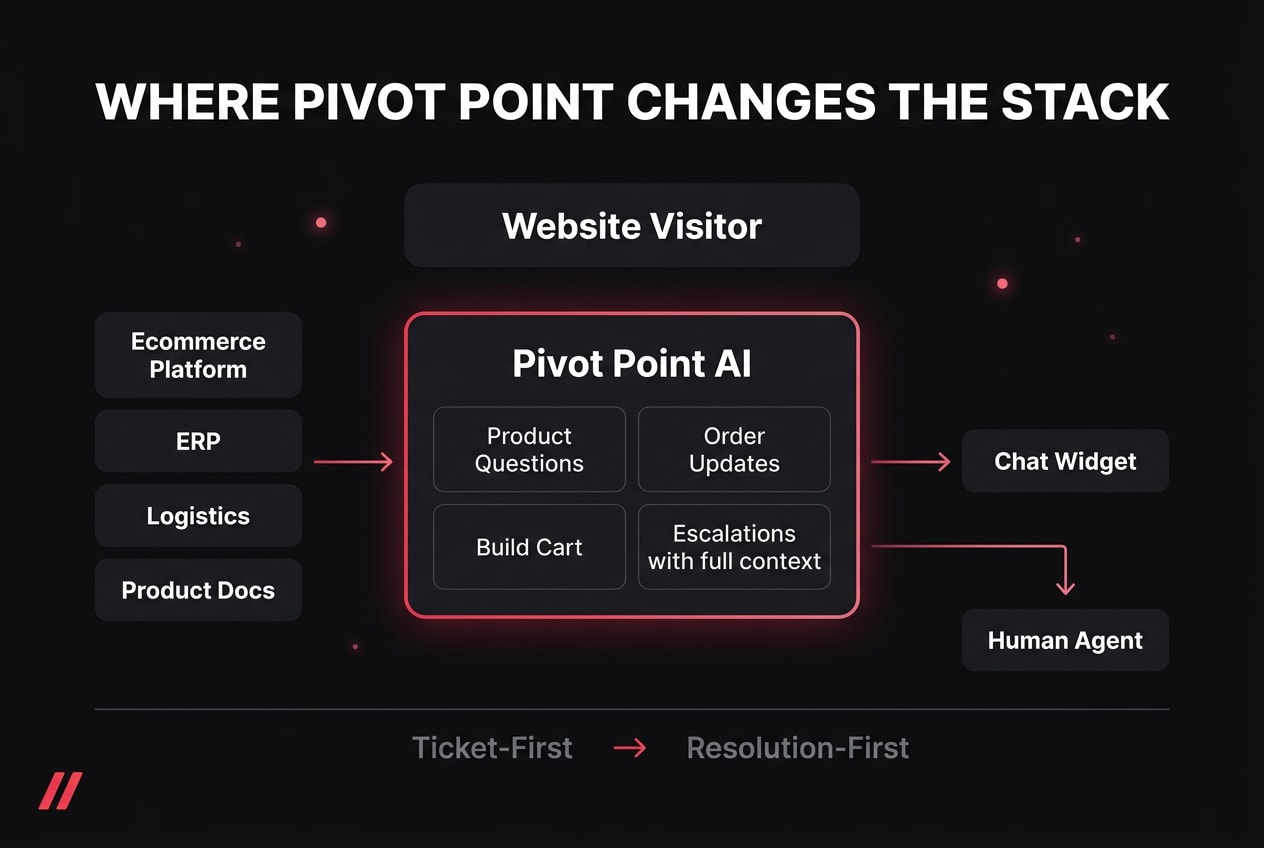
6. What changed when Pivot Point was added
Ecommerce-specific AI flows
Merchant-defined prioritisation with no hallucination risk from missing data
System integrations beyond the Shopify ecosystem
Fully managed training and tuning
Clean escalation with full context
7. The numbers side by side
| Metric | Client A before | Client A after | Client B before | Client B after |
|---|---|---|---|---|
| Sessions (comparison period) | 209,167 | 121,977 | 150,951 | 105,554 |
| Conversations | 306 | 371 | 410 | 348 |
| Helpdesk tickets | 306 | 54 | 410 | 51 |
| Conversations / 1,000 sessions | 1.46 | 3.04 | 2.72 | 3.30 |
| Live-agent tickets / 1,000 sess. | 1.46 | 0.44 | 2.72 | 0.48 |
| Engagement change | - | +108% | - | +21% |
| Ticket reduction | - | −71% | - | −82% |
| Gorgias kept? | Yes | Yes | Yes | Yes |
| Gorgias plan after? | - | Downgraded | - | Downgraded |
8. What this means for your Gorgias setup
Want to see what your numbers look like with Pivot Point in front of Gorgias?