

Many small and medium businesses want a chatbot that feels tailored to their brand, but once they start pricing training, integrations, and ongoing maintenance, the project often becomes far more expensive than expected. This article explains why that happens, what a “good” chatbot setup should look like for an SME, and how to get custom-level results without paying for a full-blown custom software build – with examples of how we approach this at Pivot Point.
1. Introduction: Why “Custom” Chatbots Confuse SMEs
What most SMEs actually want is something in the middle:
- A chatbot that understands their products and policies.
- Enough customisation to feel “on brand.”
- Integrations with ecommerce, support, or CRM tools.
- Predictable cost and a clear path from decision to go‑
2. What Small Businesses Actually Expect
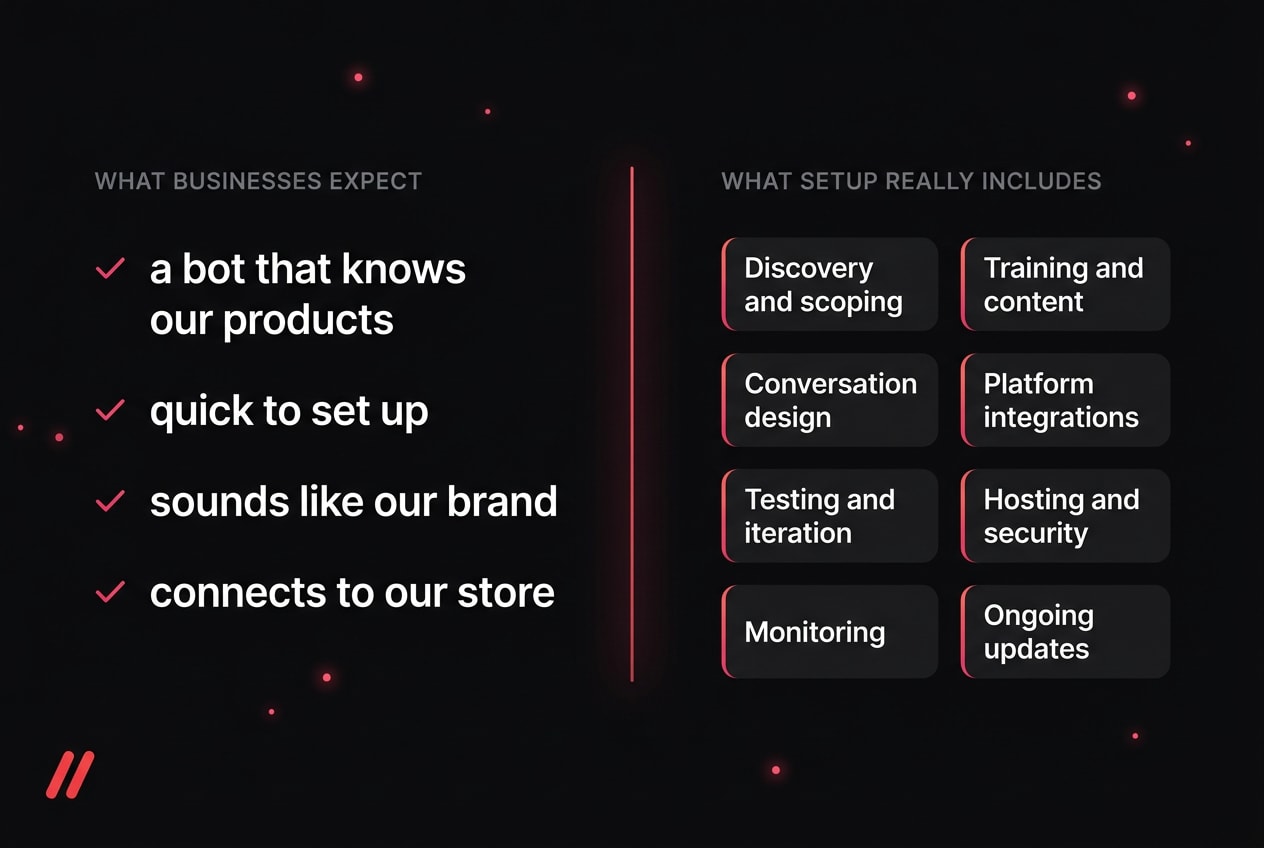
Typical expectations include:
- Fast deployment: going live in weeks rather than many months.
- Content setup: the bot can read and use website content, FAQs, policy pages and important documents.
- Brand and tone alignment: replies sound like the business, not like a generic robot.
- Basic workflow coverage: answering common questions, handling routine requests and routing trickier cases to a human.
- Integrations: at least with the website platform and ideally with support tools, email, or CRM.
- Ongoing support: someone to call when the bot is wrong, unclear, hallucinates or is missing information.
3. Why Fully Custom Builds Get Expensive
- Discovery and scoping– mapping use cases, systems, customer journeys and edge cases.
- Training data work– collecting, cleaning and structuring website content, PDFs, internal docs and historical tickets so the AI has quality information to work from.
- Conversation and workflow design– deciding how the bot should respond, what it should ask and when to hand over to a human for each scenario.
- Integrations and automation– connecting to ecommerce platforms, ERPs, CRMs, helpdesks and logistics tools so the bot can actually act, not just answer FAQs.
- Testing and iteration– catching hallucinations, broken flows, confusing answers and edge cases before launch.
- Hosting, monitoring and security– keeping the system stable, compliant and observable in production.
- Ongoing maintenance– updating content, fixing behaviour and adapting to new business needs over time.
4. The Hidden Cost After Launch
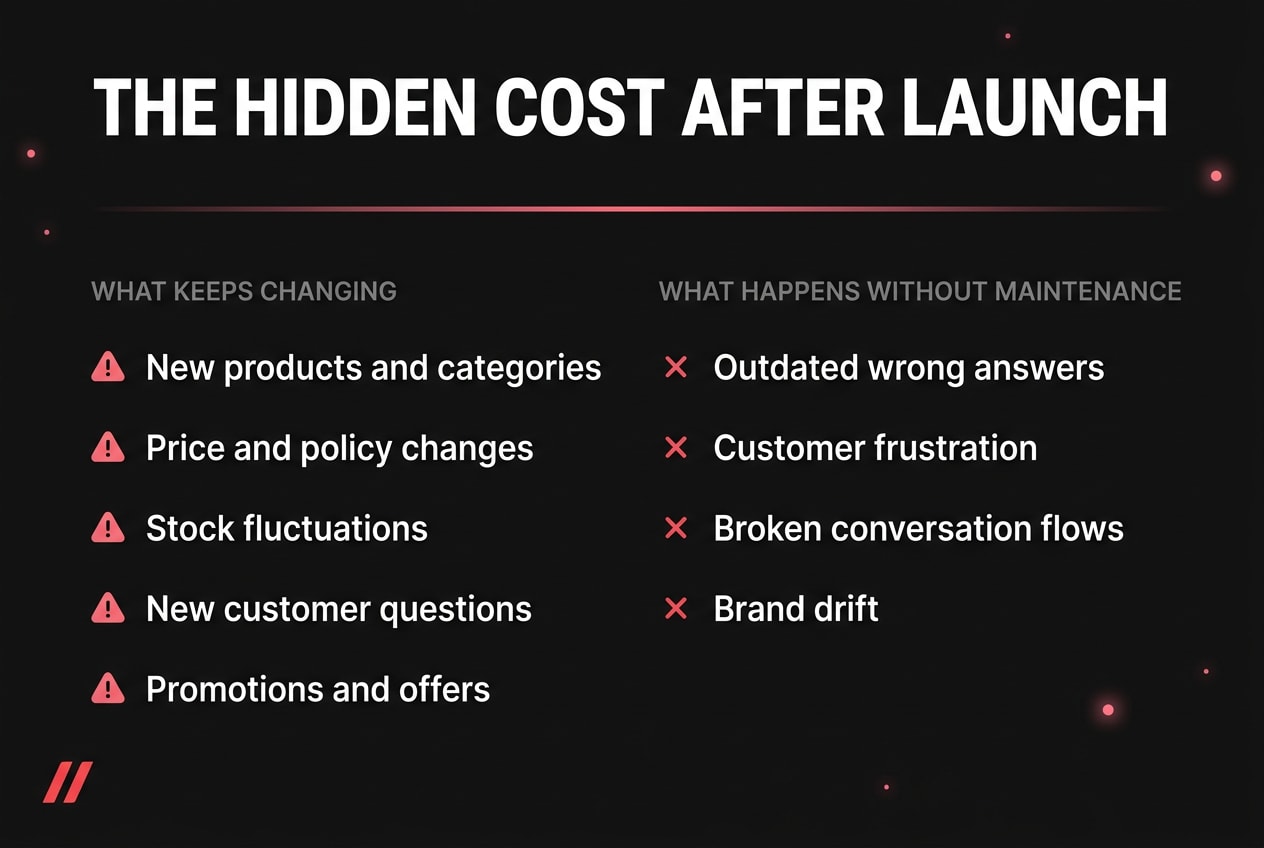
- New products, categories and bundles are added.
- Prices, shipping rules and returns policies change.
- Stock levels fluctuate and promotions come and go.
- Customers start asking new types of questions the team did not anticipate.
- Edge cases appear that were never covered in the original scope.
Without someone actively maintaining the AI, the chatbot can:
- Start hallucinating, confidently giving wrong or outdated answers.
- Loop customers through the same unhelpful responses.
- Route issues poorly, increasing frustration and ticket volume.
- Drift away from the brand’s tone, priorities, or current offers.
5. What “Good” Really Looks Like for SME Chatbots
For most small and medium businesses, a good chatbot setup is not about having the most complex architecture. It is about having a system that is reliable, adaptable and manageable over time. In practice, that means:
- A bot that can be trained on their products, services and policies without needing a data science team.
- Automatic syncing with the website or ecommerce platform so information stays current by default.
- The ability to handle real tasks: recommend products, help build carts, check orders, update details, or book appointments – not just link to FAQ pages.
- Smart handoff to humans with the conversation history attached, so customers do not need to repeat themselves.
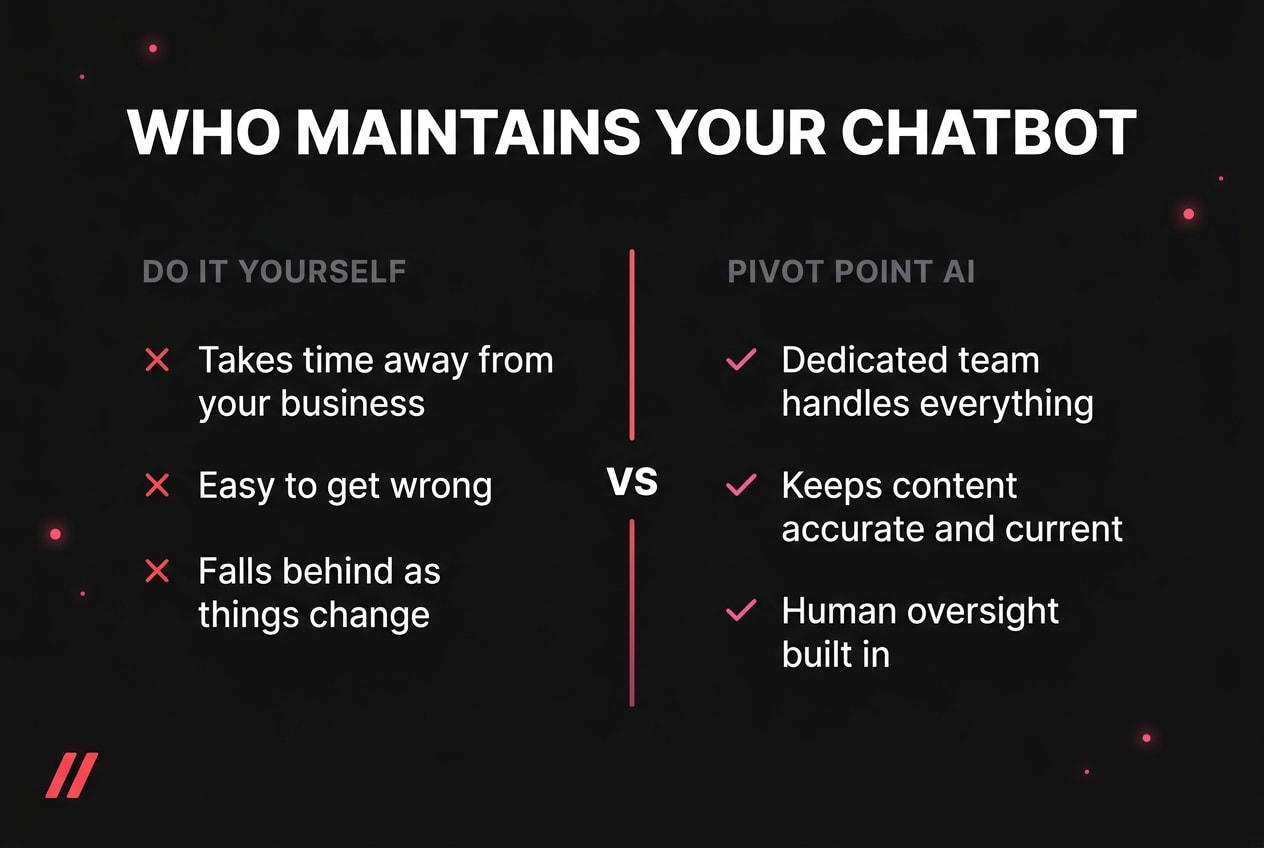
- A clear process and owner for fixing bad behaviour when it appears, so performance improves rather than decays.
6. How We Solve the Custom vs Cost Problem at Pivot Point
At Pivot Point, we have designed our platform to be highly customisable without turning into a one-off custom build. Our goal is to give small and medium businesses the benefits of a tailored chatbot – deep product understanding, real workflows, and ongoing tuning – while keeping cost, setup time, and maintenance under control.
Our solution is built to be customisable in two directions: by you and by us.
- You can control how the chatbot behaves day-to-day: what it prioritises, which content it can or cannot use, how it speaks to customers, and which data points it should collect.
- We handle the heavy lifting behind the scenes: AI training, advanced search configurations, integration work, and ongoing tuning when something needs to change or the bot gets something wrong.
In practical terms, that looks like:
- Managed AI training and tuning We set up and train the AI on your products, services, policies, and supporting documents. When you need the chatbot to respond differently – or when it hallucinates – we step in, adjust the configuration, and retrain as needed. You don’t have to become an AI engineer to keep the bot useful.
- Deep, ecommerce-focused workflows Our chatbot is built for ecommerce from day one. It can ask qualifying questions, guide customers to the right product, upsell and cross-sell, and help build or edit the cart directly through the chat. It can prioritise products based on your rules (high-margin items, in-stock items, specific collections) instead of treating everything as equal.
- Customisable search and knowledge behaviour We can control where the AI looks for answers and how it interprets industry-specific language. You can exclude confusing parts of the site, add keyword equivalents, and define which sources to trust for which kinds of questions. That gives you much finer control over accuracy than a generic “just crawl the site” bot.
- Integrations that actually do things We integrate with ecommerce platforms, ERPs, logistics providers, CRMs, and helpdesks so the chatbot can act, not just talk. It can check stock and ETAs, track orders, trigger cancellations or address changes (within your rules), and escalate to the right team with context when a human needs to step in.
- Continuous syncing and content control Our system synchronises with your website platform and can ingest documents from sources like Google Drive, so your chatbot stays aligned with the latest information. If parts of your site are not ready for the bot, we can exclude them and refine that over time.
- Flexible configuration for your team We give you controls for everyday adjustments – like phrasing, priorities, exclusions, and data capture – without forcing you to touch the underlying AI plumbing. When you want to go deeper, our team can jump in and make structural changes for you.
7. When a Fully Custom Build Still Makes Sense
It is important to acknowledge that there are scenarios where a fully custom chatbot project is the right choice. Those usually involve businesses that:
- Operate in highly specialised or regulated environments (for example, healthcare or certain finance use cases).
- Need very deep integration across many internal systems that off‑the‑shelf tools cannot reasonably support.
- Have strict compliance, data residency or security requirements that demand bespoke infrastructure and governance.
- Treat the chatbot as part of their core product rather than an internal tool, where unique capabilities become a competitive advantage.
But for the typical ecommerce or service‑based SME, the need is different. They want a chatbot that:
- Feels tailored to their business.
- Runs on top of the platforms they already use.
- Is actively managed so it improves over time.
- Does not turn into an endlessly expanding custom software project.
8. Final Thoughts
Pivot Point Chatbots are designed to give SMEs the benefits of a customised chatbot – deep product understanding, real workflows and ongoing tuning – without the cost and complexity of building everything from scratch.