INTRODUCTION
At Lightsounds (the professional audio and lighting business Rick and I built over nearly two decades, growing to 67 staff and 18 locations before selling in 2018) we stocked thousands of SKUs across lighting rigs, dimmers, speakers, amplifiers and cables. Most products had compatibility requirements. A dimmer pack that worked perfectly with one lighting fixture could destroy another. A speaker cabinet that matched one amplifier would be underpowered by the next.
Our staff knew the catalogue. More importantly, they knew how to ask before they recommended. The question was never “what are you looking for?” It was always “what are you running it with?”
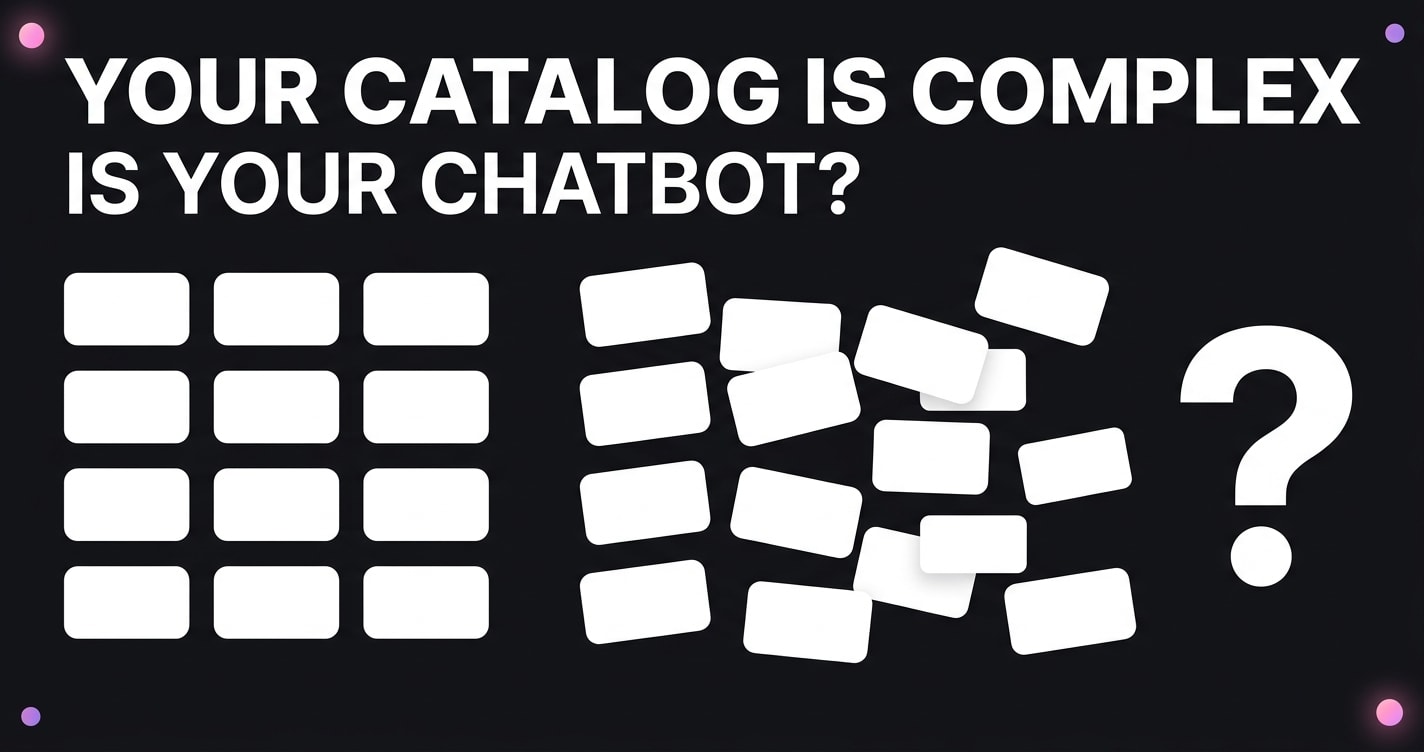
That sequencing – filter first, recommend second – is exactly what most website chatbots get wrong with complex catalogues. And the consequences are not just a frustrated customer. They are the wrong part ordered, a return processed and a brand that lost the customer’s trust at the one moment they needed the most accurate answer.
1. The problem most store owners describe the same way
If you sell products where compatibility matters – auto parts, spare parts, industrial equipment, musical instruments, electronics components, trade supplies or B2B machinery parts – you have probably already discovered that a standard website chatbot does not cut it.
Customers ask “I need brake pads that fit a 2001 Ford Falcon” and get a list of results that may or may not be right. Or they get no clear answer at all. Or worse, they get a confident answer that turns out to be wrong.
This is not a configuration problem that a bit of extra training will fix. It is a fundamental design mismatch between what generic chatbots are built to do and what complex catalogue stores actually need.
69% of retail and ecommerce teams report that at least half of their AI-powered experiences needed substantial revision after launch. [1] For stores with complex catalogues that number is almost certainly higher – because the task is harder and the margin for error is smaller.
2. Why generic chatbots fail on complex catalogues
The failure has three layers and they build on each other.
When a brake pad is compatible with 47 different vehicles across 15 years of manufacture, all of that compatibility data lives in the product description as text. A generic website chatbot reads that text the same way it reads everything else – as a block of words to match against what the customer typed.
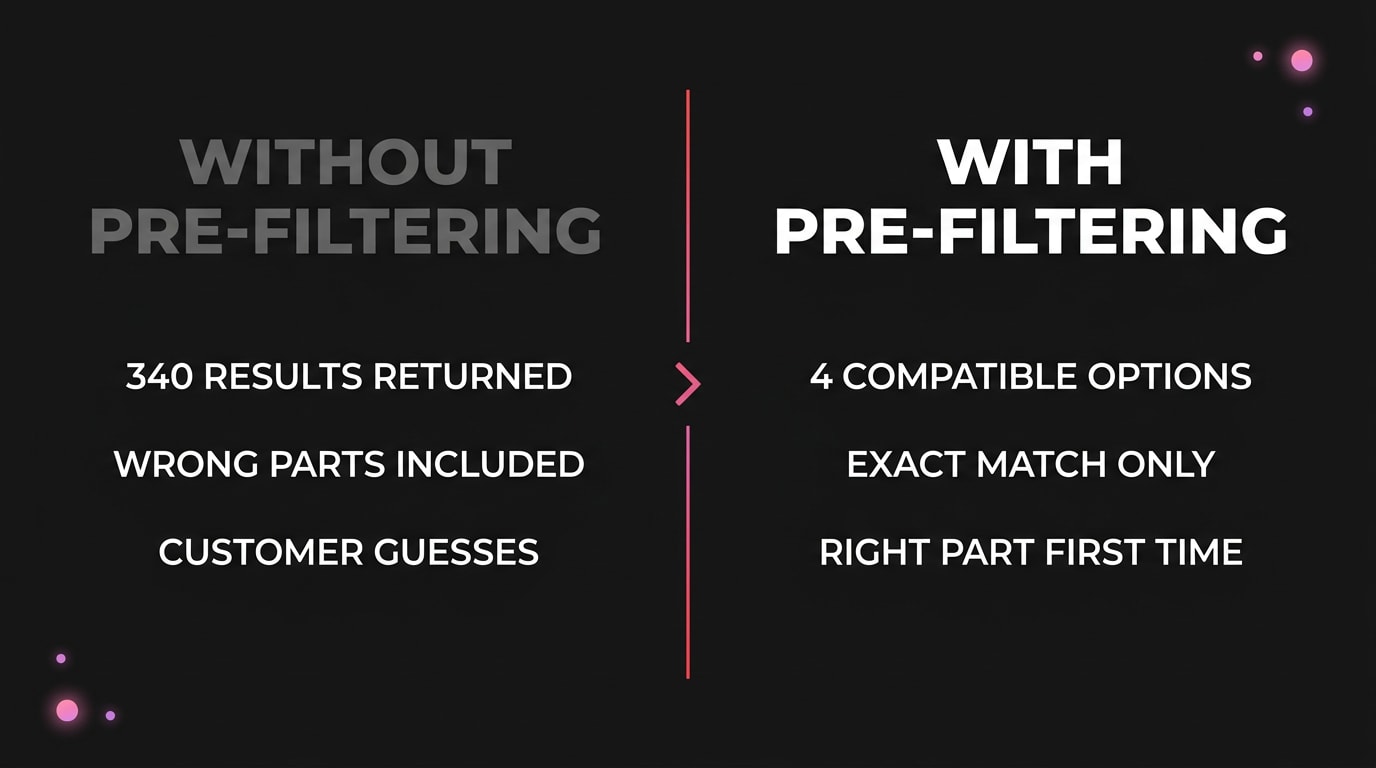
So when a customer asks for brake pads compatible with a 2001 Ford Falcon, the chatbot searches the entire catalogue and finds 340 products mentioning “brake pads,” 180 mentioning “Ford” and 90 mentioning “Falcon” across multiple years. It has no way to understand that the intersection of make, model and year is what matters. The years, makes and models mush together across hundreds of results – and the answer it gives reflects that confusion.
Generic chatbots are built to retrieve an answer as fast as possible. For a simple question – “what are your trading hours?” or “do you offer free shipping?” – that works. For a compatibility question, especially with larger catalogues, it fails completely.
The right approach is not to search first and narrow down later. It is to filter first and only then search. Make, model, year, application – established through a structured conversation before any product search begins. Most off-the-shelf tools have no guided questioning logic built in. They jump straight to search with whatever the customer typed and return whatever matches.
Asking “what are you looking for?” is the wrong first question for a compatibility catalogue. “What make, model and year are you working with?” is the right one – and that distinction has to be built into the workflow deliberately, not left to the chatbot to figure out on its own.
This is where most discussions about AI chatbots stop at model selection – “just use a better AI model” – but model selection alone does not solve it.
Two things have to happen before the AI ever gets involved in a compatibility question. The first is guided questioning, as above. The second is pre-filtering: once the filter criteria are established through conversation, the search space gets narrowed before the AI touches it.
Instead of handing the AI 340 brake pad results and asking it to find the right one, the pre-filtering step reduces that to 4 compatible options. The AI then recommends from a clean, relevant set rather than a noisy catalogue dump.
This changes the AI’s job entirely. Instead of trying to reason across hundreds of loosely related products simultaneously – which is where cheaper models fail and where even capable models drift – it is choosing between a small number of pre-validated options. That is a task a well-configured model can do accurately and consistently.
The pre-filtering step is not a feature of the chatbot. It is a design decision in how the workflow is built. Most plug-and-play tools do not offer it because it requires custom configuration for every catalogue.
3.Why custom-built is not always the answer either
The obvious response to all of this is: commission a custom-built recommendation engine. And for large enterprise retailers with a dedicated development team, that may be the right call.
For most mid-market ecommerce stores it is overkill. Months of development, significant upfront cost and an ongoing dependency on developers every time the catalogue changes, a new product range is added or a compatibility rule is updated. 74% of deployed AI chatbots get shut down or rolled back. [2] Over-engineered solutions that are expensive to maintain are a significant part of that number.
The gap between “off-the-shelf tool that cannot handle complexity” and “custom-built solution that takes six months and costs six figures” is where most store owners get stuck. It is also where the right answer actually lives.
4.What a properly built product recommendation chatbot does differently
Four things separate a chatbot built for complex catalogues from one that is not.
The chatbot opens with qualifying questions, not a search. Make, model, year, application, load rating, voltage – whatever the relevant filter criteria are for that specific catalogue. Only once those are established does the search begin. This sequence is built into the training as a deliberate workflow, not generated by the AI on the fly.
Not just the product description text but the underlying compatibility relationships. The chatbot understands that this brake pad fits these specific vehicles – not just that the words “Ford” and “Falcon” appear somewhere in the product listing. That structured understanding is what makes the pre-filtering step possible.
As described above – the AI receives a filtered, compatible set of options rather than the full catalogue noise. This is the step that makes the difference between a chatbot that confidently returns the wrong answer and one that reliably returns the right one.
New products, discontinued lines, updated compatibility data, new vehicle models added to the range. The chatbot reflects what is currently available and currently compatible – not what was in the catalogue when it was first trained.
This is the setup and ongoing management work that most plug-and-play platforms leave entirely to the store owner.
5.What this looks like in practice
One more number worth knowing: product pages across ecommerce sites average only 66% machine-readable for AI. [3] That means roughly a third of the information on a typical product page – specifications, compatibility notes, variant details – is invisible to the AI searching it. For a complex compatibility catalogue that gap is not a minor inconvenience. It is the difference between a chatbot that can do its job and one that cannot, regardless of how well everything else is configured.
6. The honest take
Not every store needs this level of sophistication. If your catalogue is small and your products are straightforward, a standard setup will handle it.
But if customers regularly ask “will this work with my vehicle, machine or system?” and your current chatbot either gets it wrong or gives a vague non-answer, that is not a limitation of AI. It is a limitation of how that particular chatbot was built.
The right product recommendation chatbot for a complex catalogue is not the most expensive one or the most technically impressive one. It is the one built with the right sequence, the right pre-filtering architecture and the right data – and maintained so it stays accurate as your catalogue evolves.
7. Conclusion
Complex catalogue stores have a specific problem that generic tools were not designed to solve. The answer is not to abandon AI or commission a full custom build. It is to implement a chatbot that filters before it searches, uses a pre-filtering layer before the AI gets involved and is maintained as the catalogue changes.
For ecommerce brands selling products where the wrong recommendation costs you a return, a negative review or a customer who never comes back, that distinction matters more than any feature list on a pricing page.
No obligation. 20 minutes. Real answers about what’s possible for your store.
ABOUT THE AUTHOR
Tala Chisholm is the founder of Pivot Point AI, a Sydney-based AI solutions business helping Australian e-commerce brands implement AI chatbots that actually work. She holds a Bachelor of Engineering (Magna Cum Laude) from the American University in Cairo, and spent nearly two decades building Lightsounds – a professional audio and lighting company that grew to 67 staff and 18 locations before being sold in 2018. She brings that real-world business experience to every client engagement. Visit pivotpointai.tech to learn more.