

Want to know how well an intelligent AI Chatbot can represent your brand? We can create a free demo chatbot for you, no strings attached

Request Free Demo

Chatbots

How we cut live-agent tickets by up to 82% for ecommerce brands still using Gorgias

Written by Tala Chisholm
Updated May 13, 2026

Free Chatbot Demo

Want to know how well an intelligent AI Chatbot can represent your brand? We can create a free demo chatbot for you, no strings attached.
TL;DR
Two ecommerce brands reduced live-agent tickets by 71-82% by adding a resolution-first AI chatbot in front of their existing Gorgias helpdesk. The article contrasts ticket-centric AI (faster handling) with resolution-first AI (fewer tickets created), covers Gorgias AI’s 2024 vs 2026 capabilities and presents real before-and-after data from both implementations.
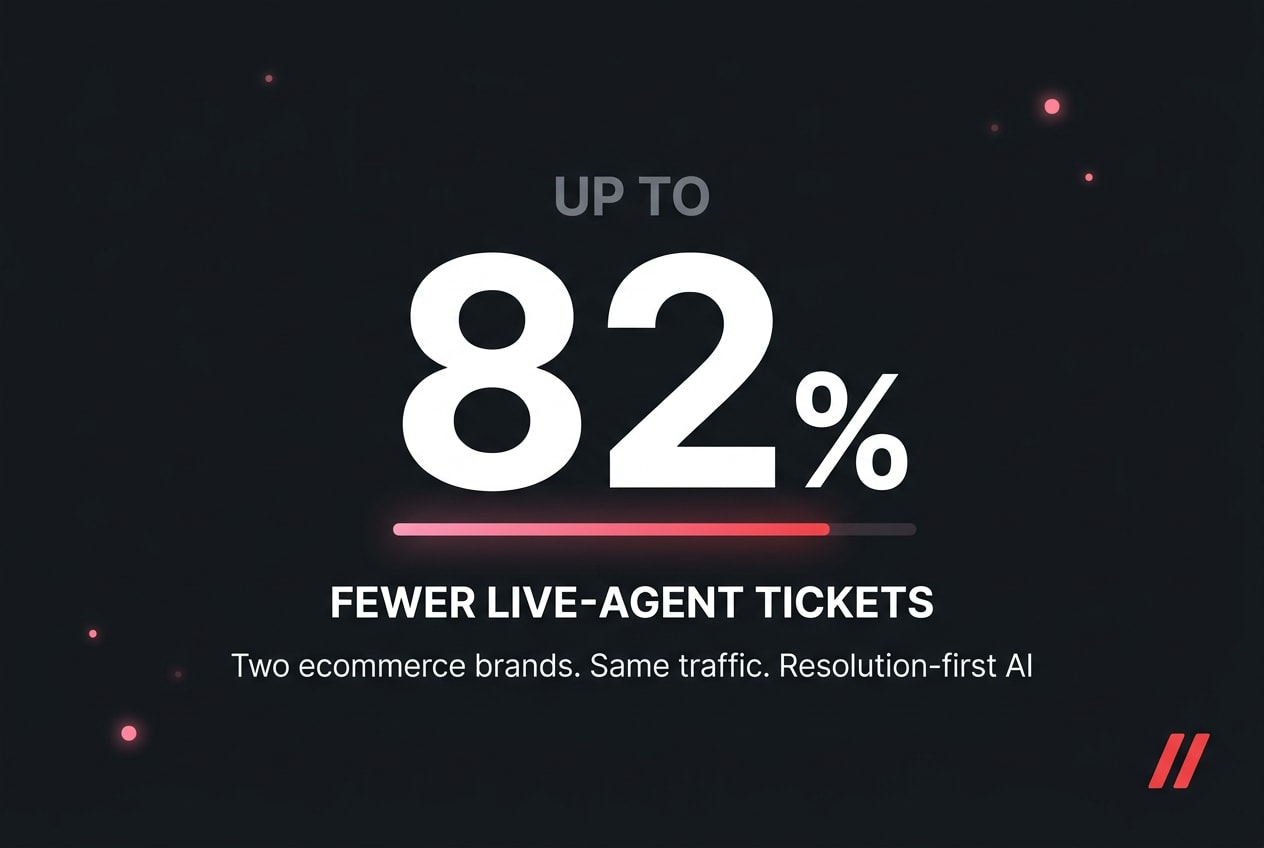
Table of Contents

Gorgias is an excellent helpdesk. This is not an article arguing against it. Both of the brands we cover here still use Gorgias today and they have no plans to change that. What we did was add Pivot Point AI in front of Gorgias to resolve more conversations before they became tickets. The results were more customer engagement, far fewer live-agent tickets and a lower Gorgias subscription for both brands. Before we share the numbers, it is worth being honest about the timing: these case studies ran in mid-2024, when Gorgias AI had considerably fewer product knowledge capabilities than it does today. We address that context directly in this article.

TL;DR

Two ecommerce brands reduced live-agent tickets by 71-82% by adding a resolution-first AI chatbot in front of their existing Gorgias helpdesk. The article contrasts ticket-centric AI (faster handling) with resolution-first AI (fewer tickets created), covers Gorgias AI’s 2024 vs 2026 capabilities and presents real before-and-after data from both implementations.

Article_Gorgias_vs_PivotPoint_2_replacement

1. Why AI inside a helpdesk is not the same as AI in front of it

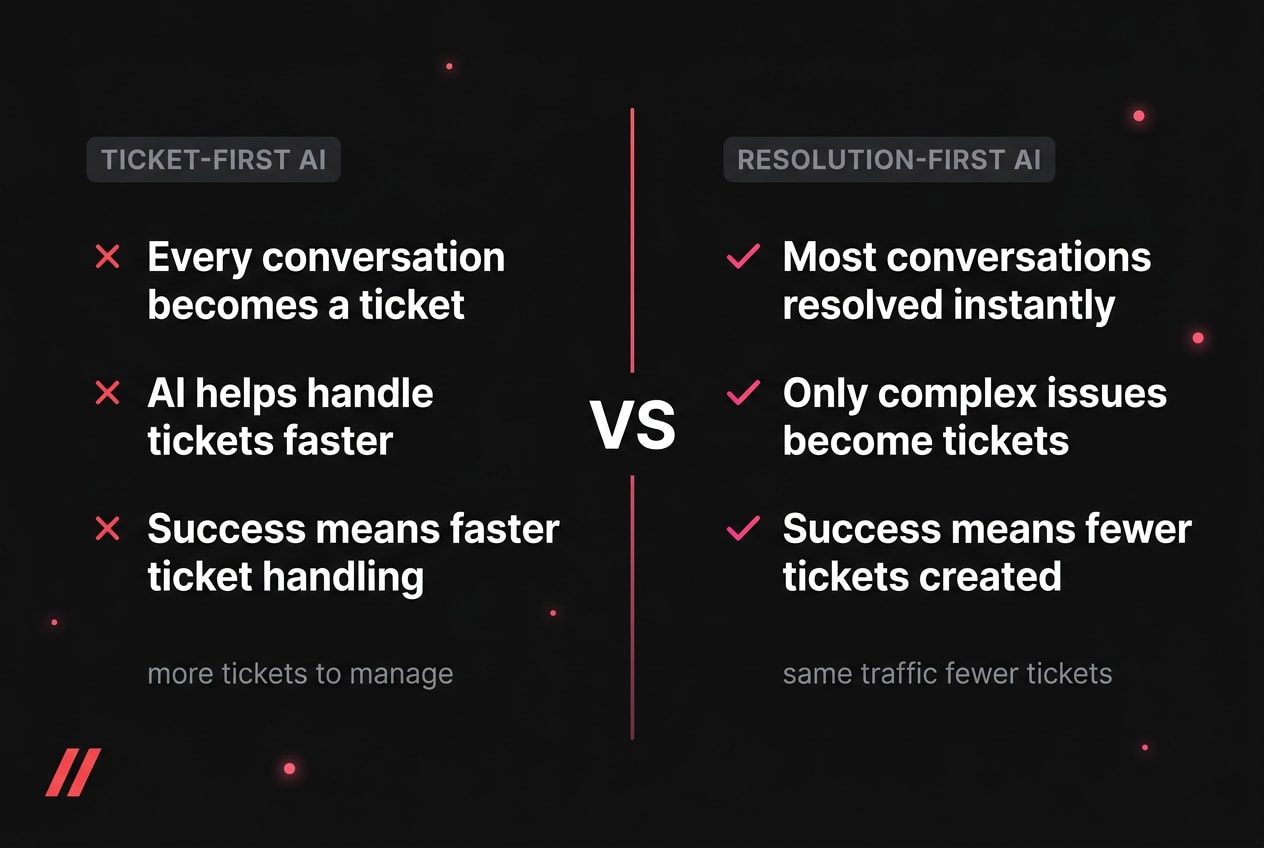
Gorgias is built around the ticket. A customer initiates a conversation. That conversation becomes a ticket. The ticket is categorised, prioritised and handled by an agent or an AI assistant that helps the agent respond faster. That is a genuinely useful model and Gorgias executes it well.
The problem is that the architecture assumes a ticket is the right unit of work. In that model, every conversation is a ticket waiting to happen. The AI makes tickets easier to handle. It does not, by design, reduce how many tickets exist.
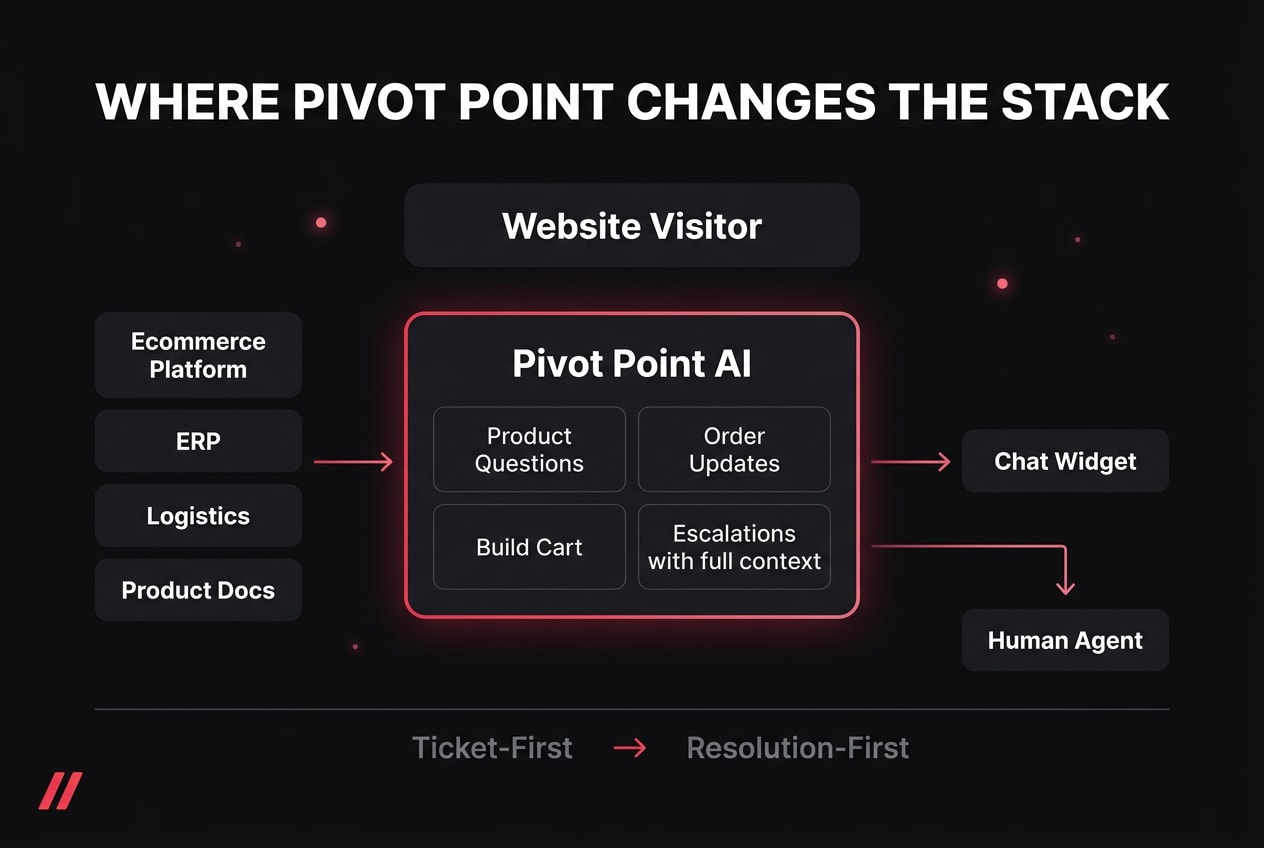
Pivot Point is designed around a different assumption: that the goal is resolution before a ticket is created. Most ecommerce conversations are answerable. A customer asks about a product, gets a helpful answer and buys. A customer asks about their order status, gets a live update and is satisfied. Neither of those conversations needed to become a ticket. Pivot Point handles them on the website or channel before they reach Gorgias. Only conversations that genuinely require a human are escalated – and when they are, the full context travels with them.
Gorgias is where our clients handle their hard tickets. Pivot Point is where they stop easy ones becoming tickets in the first place.

2. Ticket-first AI vs resolution-first AI

The distinction is worth making explicit, because it changes what success looks like.
In a ticket-centric system, success is a well-handled ticket: fast response, accurate resolution, high CSAT. AI features inside Gorgias – automated replies, suggested responses, AI triage, the Shopping Assistant – are all designed to make that process faster and cheaper per ticket.
In a resolution-first system, success is fewer tickets and more resolved conversations. The bot is designed to answer, guide and act – and only hand off when it cannot. The metric is not ‘how quickly did we handle this ticket?’ but ‘how many conversations never became tickets at all?’
Ticket-first AI (inside helpdesk) Resolution-first AI (in front of helpdesk)
Conversation starts → ticket created → AI helps handle it Conversation starts → AI resolves it → ticket only if escalation needed
AI reduces ticket handling time AI reduces ticket volume
Metric: CSAT, response time, resolution rate per ticket Metric: conversations per 1,000 sessions, tickets per 1,000 sessions
Works well when tickets are unavoidable Works well when most conversations are answerable
Success = well-handled ticket Success = conversation resolved before becoming a ticket
Both models have value. The question is what you are trying to optimise. These two case studies show what the resolution-first model produces for ecommerce stores that already have Gorgias in place.

3. A note on Gorgias AI: what it could do in 2024 and what it can do now

Transparency matters here. The case studies in this article ran in mid-to-late 2024, at a point when Gorgias AI was primarily focused on helping agents handle support tickets faster and only handled support tickets e.g. enquiries like ‘where is my order’. It could classify tickets, suggest replies and summarise conversations. What it could not do was answer meaningful product knowledge questions or proactively guide shoppers to the right items. That is no longer the full picture.

What Gorgias AI can do today (2026)

Gorgias has invested significantly in AI product capabilities since mid-2024. With the release of AI Agent 2.0 and the Shopping Assistant, Gorgias AI can now do the following in a way that it could not when these case studies ran:

  • Answer detailed product questions using catalogue data, product pages and custom product fields.
  • Surface suggested product questions proactively above the chat widget, so shoppers get quick answers without searching.
  • Recommend products based on cart contents, browsing behaviour and real-time Shopify inventory data.
  • Handle WISMO queries with automated responses and self-service order tracking.
  • Allow agents to cancel orders, issue refunds and edit shipping addresses directly from the Gorgias interface.

This is a material improvement on what existed in 2024 and it is worth acknowledging directly.

Where the limitations still are

That said, independent deep dives and user feedback consistently flag some constraints that remain as of 2026:

  • Suggested product questions are largely autopilot – merchants cannot directly control which prompts appear. For stores with niche or complex catalogues, this can produce generic or unhelpful suggestions that do not reflect the most common or commercially important questions.
  • The AI can still answer product questions overconfidently when the underlying content is incomplete or ambiguous. Independent reviews note cases of incorrect dimensions, wrong compatibility statements and inaccurate stock information when product data is sparse or inconsistent.
  • Strong results depend on a well-maintained knowledge base and product catalogue. If information is scattered, missing or structured inconsistently, AI reliability degrades – and that maintenance is the merchant’s responsibility, not Gorgias’s.
  • Platform coverage remains Shopify, BigCommerce and Magento. WooCommerce, Neto, Wix, Opencart are not supported. In addition, if the merchant is using an external logistics provider like Starshipit or Shipit, Gorgias has no access to those and therefore cannot answer tracking details that live in the logistics platforms.
Capability Gorgias AI (mid-2024, when case studies ran) Gorgias AI (current, 2026)
Product Q&A Not available. Agents handled all product questions manually. AI Agent 2.0 and Shopping Assistant can answer detailed product questions using catalogue data, product pages and custom product fields. Suggested product questions surface proactively above the chat widget.
Product recommendations Not available. No AI-driven product surfacing. Shopping Assistant can recommend products based on cart contents, browsing behaviour and catalogue data, with real-time inventory awareness for Shopify stores.
Order support (WISMO) AI-assisted ticket handling only. Agents handled all WISMO queries. Gorgias could handle some basic WISMO queries Automated WISMO replies and self-service order tracking available. Agents can cancel, refund and edit orders directly from the Gorgias interface.
Knowledge base control Limited - Gorgias AI had minimal configurable knowledge. Merchants can enrich content via help-centre articles, product fields and custom data. AI draws from all of these for responses.
Suggested question control Not applicable. Limited - suggested questions are largely autopilot. Merchants cannot directly control which prompts appear, which can produce generic or unhelpful suggestions for niche catalogues.
Hallucination risk Low for support FAQs; high for product specifics. Reduced for well-maintained catalogues. Independent reviews still flag overconfident answers on incomplete product data - incorrect dimensions, compatibility statements or stock status - when underlying content is missing or ambiguous.
Platform support Shopify, BigCommerce, Magento. Shopify, BigCommerce, Magento. WooCommerce remains unsupported.
Setup and maintenance Merchant-managed; required significant manual configuration. Still merchant-managed. Results depend on a well-maintained knowledge base and product catalogue. If content is scattered or missing, AI reliability degrades.

What this means for the case studies

Important context

The results below – 71% and 82% ticket reductions – were achieved against a version of Gorgias AI that did not yet offer meaningful product knowledge or proactive recommendation capability. A direct comparison run today would be against a stronger Gorgias AI baseline. We believe the results would still be materially positive, for the reasons covered in Sections 6 and 8, but we think it is important to state the context clearly rather than imply the results were achieved against Gorgias at its current capability level.

4. Client A: 71% fewer live-agent tickets, 108% more engagement

Client A is an ecommerce brand that had been using Gorgias as their helpdesk, with all chat conversations becoming tickets. In the five months prior to Pivot Point going live, they handled 306 conversations from 209,167 website sessions – a conversation rate of 1.46 per 1,000 sessions. Every one of those 306 conversations became a helpdesk ticket, averaging 61.2 per month.

Before: Gorgias Helpdesk and AI (February - June 2024)

The low engagement rate – fewer than 1.5 conversations per 1,000 visits – was a signal in itself. The chat function was present but not being found or used by most visitors. Every customer who did reach out generated a ticket that the support team handled manually.
Client A - results summary
Metric Gorgias only (Feb-Jun 2024, 5 months) Pivot Point + Gorgias (Aug-Oct 2024, 3 months) Change
Website sessions 209,167 121,977 Different period
Conversations 306 371 +65 more
Helpdesk tickets 306 54 −252 fewer
Conversations / 1,000 sessions 1.46 3.04 +108% engagement
Live-agent tickets / month 61.2 18 −71% reduction

After: Pivot Point AI + Gorgias (August - October 2024)

Three months after the Pivot Point Chatbot went live, on fewer total sessions (121,977 versus 209,167), the store saw more total conversations (371 versus 306). Conversations per 1,000 sessions had more than doubled, from 1.46 to 3.04 – a 108% increase. More customers were engaging with the chat because it was now giving useful answers rather than mostly routing them to a queue.
Helpdesk tickets dropped from 306 to 54 over the comparable period. Live-agent tickets per month fell from 61.2 to 18 – a 71% reduction. The bot was handling the majority of conversations end-to-end, escalating only where genuinely needed. Client A was subsequently able to move to a lower Gorgias ticket plan, reducing platform subscription costs alongside the labour savings.

More customers talking to the chatbot. Far fewer tickets reaching the human team. Both changes happening at the same time.
Article_Gorgias_vs_PivotPoint_3_replacement

5. Client B: 82% fewer tickets, even with Gorgias AI already running

Client B had Gorgias AI active during the comparison period: Gorgias AI versus Pivot Point AI, both sitting in front of the same Gorgias helpdesk with live-agent escalation available in both scenarios.

Before: Gorgias AI + live agents (June - August 2024)

With Gorgias AI running, Client B handled 410 conversations from 150,951 sessions – a conversation rate of 2.72 per 1,000 sessions. 410 conversations became a helpdesk ticket. The AI was helping agents respond faster; it was not resolving conversations before they reached agents. Live-agent tickets per 1,000 sessions was 2.72 – identical to the conversation rate.
Client B - results summary
Metric Gorgias AI + live agents (Jun-Aug 2024, 3 months) Pivot Point + Gorgias (Oct-Nov 2024, 2 months) Change
Website sessions 150,951 105,554 Different period
Conversations 410 348 Fewer sessions, higher rate
Helpdesk tickets 410 51 −359 fewer
Conversations / 1,000 sessions 2.72 3.30 +21% engagement
Live-agent tickets / 1,000 sessions 2.72 0.48 −82% reduction

After: Pivot Point AI + Gorgias (October - November 2024)

On 105,554 sessions, there were 348 conversations and 51 helpdesk tickets. Conversations per 1,000 sessions rose from 2.72 to 3.30 – a 21% increase in engagement despite fewer total sessions. Live-agent tickets per 1,000 sessions fell from 2.72 to 0.48 – an 82% reduction.
Of 348 conversations, 297 were fully resolved by Pivot Point Chatbot without becoming tickets. The 51 that escalated went to Gorgias with full conversation context attached, so agents could continue immediately without asking the customer to re-explain.

Gorgias AI (2024 version): 410 conversations, 410 tickets. Pivot Point: 348 conversations, 51 tickets. The difference was not faster ticket handling – it was preventing most tickets from being created.

Like Client A, Client B downgraded their Gorgias ticket plan following the reduction in volume, compounding the cost savings beyond labour alone.

Still using Gorgias? That doesn’t need to change.

Pivot Point sits in front of your Gorgias setup and handles what it can before tickets are created. Your team only sees the conversations that actually need them.
Book a walkthrough of your Gorgias account

6. What changed when Pivot Point was added

In both implementations, the same Gorgias Helpdesk setup remained in place. What changed was the layer in front of it.

Ecommerce-specific AI flows

The Pivot Point bot was trained on each client’s specific catalogue, policies and customer language from day one. It handled product enquiries with qualifying questions designed around the actual product range – not a generic template applied to every conversation. It handled WISMO queries by pulling live order and tracking data. It guided customers through cart-building, upsell and cross-sell flows tailored to each store’s priorities. The difference between this and Gorgias AI’s autopilot suggested questions is directional control: we design the flows, we decide what the bot asks and when and we update those flows as the store evolves.

Merchant-defined prioritisation with no hallucination risk from missing data

Gorgias AI’s product knowledge capability is only as good as the underlying product data. Independent reviews consistently flag that incomplete or ambiguous product content leads to overconfident answers and occasional inaccuracies. Pivot Point addresses this differently: we build the knowledge base collaboratively with the client, including keyword equivalents, compatibility rules, internal documents and structured product attributes beyond what lives on the product page. We also monitor conversation logs and correct errors actively. If the AI hallucinates, we can stop that from happening using our advanced training processes.

System integrations beyond the Shopify ecosystem

Gorgias’s order management and product data capabilities are excellent within Shopify. For stores on WooCommerce, Neto or a custom platform and for stores using ERPs like SAP or Unleashed alongside their ecommerce platform, Gorgias has no answer. Pivot Point integrates across platforms and can connect to logistics providers like Starshipit for live carrier data, giving the bot answers that reflect the full operational picture. Pivot Point also has the flexibility to build new platform integrations FAST when compared with SaaS-only-focused platforms like Gorgias and others.

Fully managed training and tuning

Neither client had to maintain the bot themselves. Pivot Point identified gaps where the bot was underperforming and updated the training accordingly. This is the practical difference between a self-serve platform that improves when the merchant logs in and makes changes and a managed service that improves continuously as part of the ongoing engagement.

Clean escalation with full context

When a conversation required a human, the full transcript was passed to Gorgias automatically. The agent saw everything: what the customer asked, what the bot said, what data was retrieved and where the resolution stalled. The customer did not repeat themselves.

7. The numbers side by side

Across both clients, the pattern is consistent: engagement up, tickets down, Gorgias kept, Gorgias plan downgraded.
Metric Client A before Client A after Client B before Client B after
Sessions (comparison period) 209,167 121,977 150,951 105,554
Conversations 306 371 410 348
Helpdesk tickets 306 54 410 51
Conversations / 1,000 sessions 1.46 3.04 2.72 3.30
Live-agent tickets / 1,000 sess. 1.46 0.44 2.72 0.48
Engagement change - +108% - +21%
Ticket reduction - −71% - −82%
Gorgias kept? Yes Yes Yes Yes
Gorgias plan after? - Downgraded - Downgraded
The engagement increase reflects the fact that a bot trained to give genuinely useful answers gets used more. Customers who would have abandoned a product question or searched for a tracking email instead got an answer in the chat. The ticket reduction reflects the fact that those resolutions happened in the conversation, not in a helpdesk queue.

8. What this means for your Gorgias setup

If you are running Gorgias in 2026 with AI Agent 2.0 or the Shopping Assistant active, the comparison is more nuanced than it was in 2024. Gorgias AI can now handle meaningful product questions and recommendations for stores with well-maintained Shopify catalogues. For those stores, the question is not whether Gorgias AI is more capable – it is – but whether it is producing the ticket reduction and engagement rate you need.
The limitations that independent reviews flag – limited control over suggested questions, hallucination risk on incomplete product data, Shopify/Magento/Bigcommerce-only platform coverage, merchant-managed maintenance – are structural. They are not configuration problems that a better prompt or a cleaned-up product page fully solves. They reflect the difference between AI built to sit inside a helpdesk and AI built to resolve conversations before they become tickets, trained and managed by specialists who work with your catalogue directly.
Both clients in this article still use Gorgias. They just use it for the tickets that actually require it.

Want to see what your numbers look like with Pivot Point in front of Gorgias?

Share your monthly sessions and ticket volume. We’ll map the impact and walk through your Gorgias account with you. No lock-in, monthly agreements.
Book a discovery call 

Free Chatbot Demo

Want to know how well an intelligent AI Chatbot can represent your brand? We can create a free demo chatbot for you, no strings attached

Keep reading

At Lightsounds (the professional audio and lighting business Rick and I built over nearly two decades,
At Lightsounds (the professional audio and lighting business my husband Rick and I built over nearly two decades,
I’m going to start this one differently than you might expect from someone who builds chatbots for a living.

Want to see what we'd build for your business?

Book a free demo and test a chatbot trained on your own website content, no obligation.