

AI chatbots are being deployed faster than they are being done well. Businesses install them to reduce support costs. Customers encounter them and leave frustrated. The gap between those two outcomes is where brand damage happens, quietly and at scale. This article names the nine most common failure modes – with data behind each one – and explains exactly how an ecommerce-focused, managed AI implementation avoids them.
TL;DR
The article identifies nine common AI chatbot failure modes – including deflection over resolution, inability to reach a human, hallucinations, looping and poor handoff – backed by CX research from Forrester, Verint and PwC. Each failure mode is explained with data and paired with a contrasting implementation approach that addresses it.
The AI backlash in customer service
About half of consumers say chatbots often leave them frustrated and roughly 40% describe their overall chatbot interaction history as negative. (Forrester / Cyara)
More than two-thirds of consumers have had a bad chatbot experience – most commonly because the bot could not answer questions or understand what they needed. (Verint survey of 1,500 consumers)
After a negative chatbot experience, roughly 30% of customers were highly likely to abandon their purchase or switch to a different brand. (Forrester / Cyara)
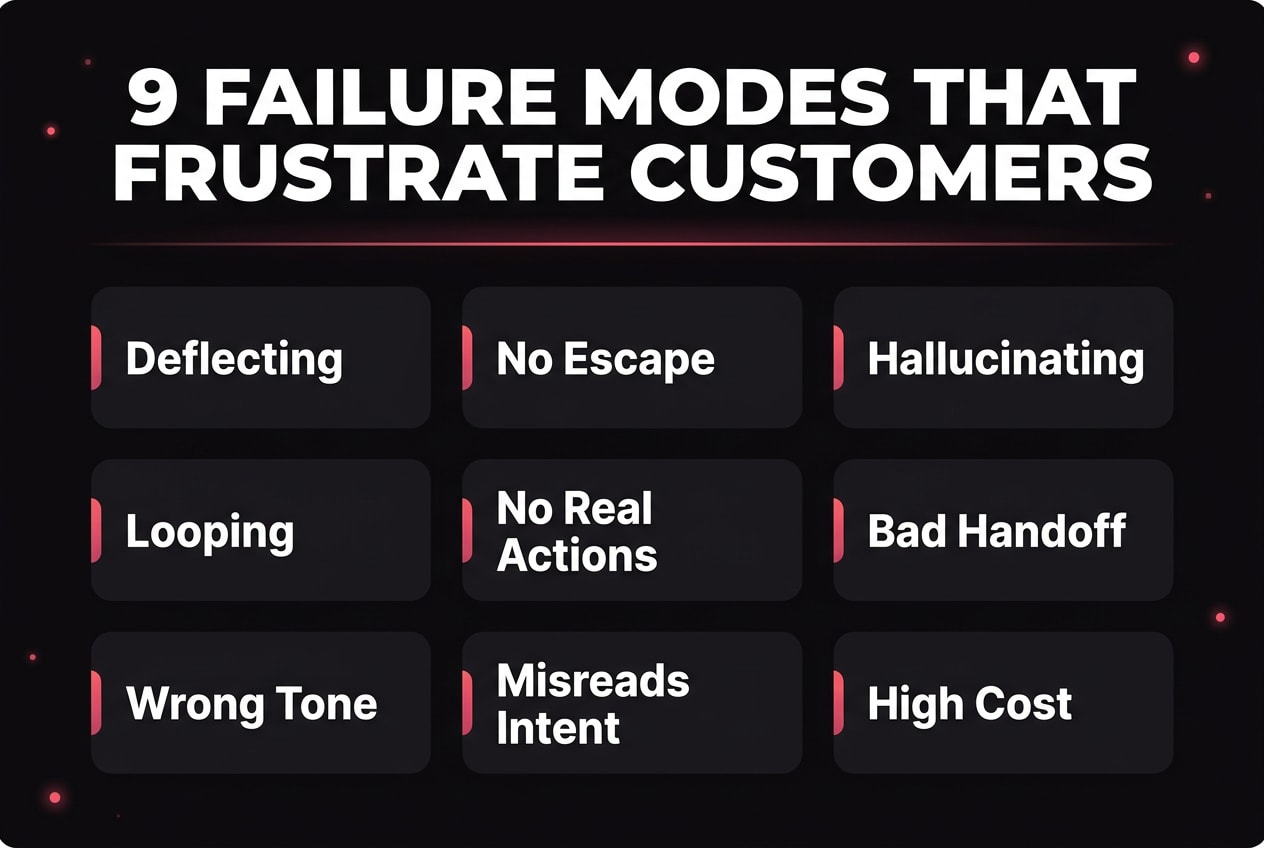
1. The bot that deflects instead of resolves
After a good chatbot interaction, customers are more likely to use chat again and view the brand positively. After a bad one, 30% abandon their purchase or switch to a different brand. (Forrester / Cyara)
52% of consumers say they stopped buying from a brand after a bad product or service experience and another 29% walked away because of poor overall customer experience. (PwC 2025 Customer Experience)
The deflection failure
- Bot configured to reduce tickets, not resolve issues
- Success measured by deflection rate, not resolution rate
- Customer leaves without an answer and without a human
- Compounds across peak periods when the bot is most needed
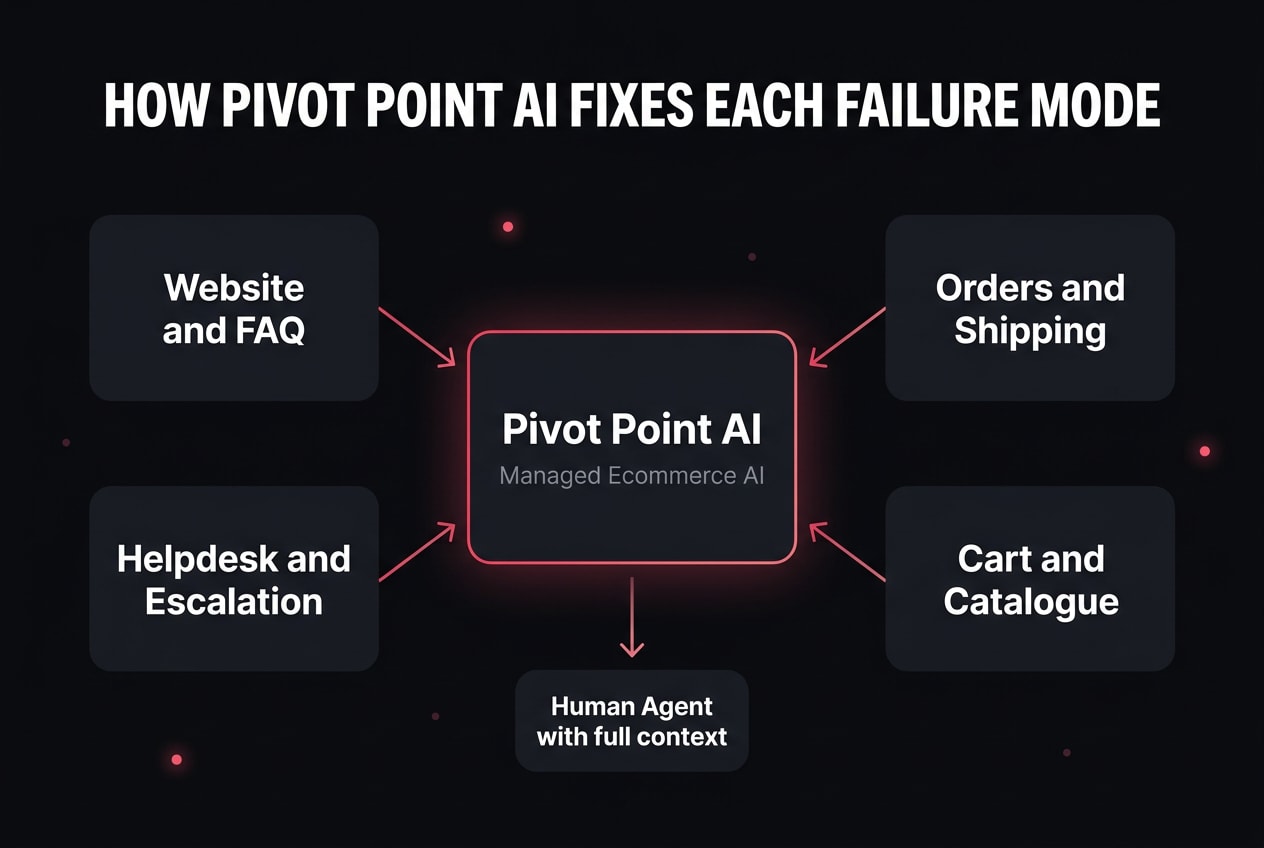
The Pivot Point approach
- We measure success as resolved conversations and completed carts
- Flows designed to either answer the question or escalate fast
- Human handoff is a feature, not a fallback of last resort
- Every escalation includes full context so the customer is not starting over
2. The bot you cannot escape
More than two-thirds of customers have had a bad experience with a self-service system and the inability to reach a live agent is one of the most common complaints. (Verint)
More than half of consumers walk away from brands after poor experiences, often without complaining. (PwC 2025 Customer Experience)
The no-escape failure
- Live chat removed or buried to force bot usage
- Escalation path exists in theory but is difficult to trigger
- Customer feels trapped; helplessness turns to frustration
- Most damaging for high-value or emotionally charged interactions
The Pivot Point approach
- Human handoff is always available and easy to trigger
- Bot designed to recognise when it should not persist
- Escalation goes to client’s helpdesk (Gorgias, LiveChat, Podium or our own Helpdesk application) with full context
- Customer never has to repeat themselves after handoff
3. The bot that answers confidently and incorrectly
Hallucination – where an AI generates factually wrong information with full confidence – is one of the most discussed failure modes in AI. In ecommerce, the consequences are concrete: a product claimed to be compatible when it is not; dimensions quoted incorrectly; a return window or discount misrepresented. Each of these creates a downstream problem: a return, a complaint, a refund or a customer who simply never trusts the brand again.
Analyses of large language models suggest they often use more confident language when they are wrong than when they are right (LLM research commentary)
Wrong product information, incorrect dimensions and false compatibility statements are among the most commonly cited consequences of AI hallucinations in ecommerce. (Multiple independent sources)
The hallucination failure
- Bot trained on generic web search or unstructured, incomplete product data
- Inadequate AI training guidelines on how to handle missing data
- Customer makes a purchase decision based on false information
- Returns, complaints and lost trust follow
The Pivot Point approach
- Training uses controlled, verified sources: website, ERP, logistics feeds and internal docs
- Content exclusions and scope controls prevent out-of-source answers
- Bot trained to say it does not know rather than guess
- We correct inaccuracies as they appear
4. The bot that loops
Customers are most annoyed by bots that do not understand what they need, take too long to solve problems or make them start over. (Forrester CX research)
Many customers feel chatbots often fail to resolve their issue, give irrelevant answers or force them to restart the conversation with a human. (Zendesk CX Trends)
The looping failure
- Keyword-triggered flows that cannot adapt to rephrased questions
- Same FAQ response regardless of customer clarification
- Customer abandons in frustration; internally counted as ‘deflection’
- Particularly damaging for complex or multi-step queries
The Pivot Point approach
- Large language model foundation understands intent, not just keywords
- Conversation flows adapt based on what the customer actually says
- Explicit complexity thresholds: bot escalates rather than persisting incorrectly
- Ongoing monitoring identifies looping patterns and we address them
5. The bot with no real power
The most common chatbot pain points are the bot’s inability to answer questions and its failure to understand what the customer needs. (Verint survey of 1,500 consumers)
Chatbots capable of real actions sit in a very different cost bracket from FAQ-only tools. (2026 pricing guides)
The no-power failure
- Bot can describe actions but cannot execute them
- Order status, address changes and cart edits all end with ‘contact support’
- Customer pushed into a queue after completing a full chatbot conversation
- Overall experience worse than if the chatbot had never existed
The Pivot Point approach
- Live integrations with ecommerce platform, ERP and logistics provider
- Bot can look up orders, check stock, read live tracking and act within defined rules
- Actions include: cancellations within time windows, address changes before pick and substitution suggestions for out-of-stock items
- Works across Shopify, WooCommerce, BigCommerce, Neto , SAP, Unleashed and others – not limited to one platform
Want to see what action capable AI looks like for your store?
We’ll walk through the specific integrations and flows relevant to your platform and catalogue.
6. The bot that forgets everything at handoff
Failed handoffs are identified as a key source of chatbot frustration. (Forrester CX commentary / Cyara testing reports)
Many customers cite having to restart the conversation with an agent as one of the most annoying aspects of chatbots. (Zendesk CX Trends)
The context-loss failure
- Handoff passes no conversation history to the agent
- Customer must re-explain their situation from the beginning
- Agent starts without order details, issue description or prior context
- Trust and patience exhausted before the human conversation starts
The Pivot Point approach
- Full conversation transcript passed to the helpdesk on escalation
- Includes: what was asked, what the bot said, data retrieved and where it stalled
- Compatible with Gorgias, LiveChat, Podium and other helpdesks
- Agent picks up mid-conversation, not from scratch
7. The bot with the wrong tone
Many customers feel that AI systems lack empathy and that the company does not care about their experience. (CX research and practitioner commentary)
Customers feel deceived when they realise they have been interacting with a bot that pretended to be human. (Consumer surveys)
The tone failure
- Single tone setting applied to all conversations regardless of context
- Cheerful responses to complaints, returns or distressing situations
- Robotic responses in contexts that call for warmth or urgency
- Bot persona that feels deceptive or misaligned with the brand
The Pivot Point approach
- Tone and style configured to match each client’s brand voice
- Different modes for pre-purchase sales conversations versus post-purchase support
- We never configure a bot to pretend to be human
- Ongoing tuning based on real conversations so the bot does not stay in ‘default mode’
8. The bot that misreads context
Page and context awareness – knowing which product, category or cart the customer is looking at – allows bots to provide far more precise answers and reduce friction. (Ecommerce UX research)
The context failure
- No awareness of which page the customer is viewing
- Generic answers where page-specific answers were possible
- No geolocation awareness for store finder, shipping or stock queries
The Pivot Point approach
- Page-aware context: bot knows what the customer is currently viewing
- Geolocation awareness for location-specific queries
- Responses adapt to current page, cart state and browsing context
9. The bot that costs a fortune to make good
Enterprise-grade chatbots with genuine system integrations typically cost $50,000-$500,000 to build and deploy, not including ongoing maintenance. (2026 enterprise chatbot pricing guides)
Basic SaaS tools at the other end of the market are cheap to install but do not do the things that actually prevent support tickets and drive revenue. (2026 pricing guides)
The cost failure
- Basic SaaS tools are affordable but incapable of real ecommerce action
- Enterprise builds are capable but require $50k-$500k investment
- Neither option serves the SME ecommerce store well
- Cheap bot deployed, customer experience suffers, tickets not reduced
The Pivot Point approach
- Fully managed, ecommerce-specific AI at fixed monthly retainer pricing
- No custom build or internal technical team required
- Ongoing training, tuning and maintenance included
- Enterprise-style capability without traditional enterprise implementation costs
Fixing these problems is not about the AI model
The common thread across all nine failure modes is that none of them are primarily problems with the underlying AI technology. They are problems with how that technology is deployed, trained, integrated and maintained. The same language model that loops, hallucinates and deflects in a poorly configured bot can deliver accurate, contextual, action-capable responses in a well-configured one.
The difference is the layer between the model and the customer.
For ecommerce specifically, that layer needs to be trained on your catalogue, your policies and your commercial priorities. It needs to be connected to your platform, your ERP and your logistics provider. It needs to be tuned continuously as your business changes. And it needs to be managed by people who understand both AI and ecommerce well enough to know when the bot should answer, when it should ask and when it should hand off.
That is what Pivot Point is built to be. Not a widget you install and forget, but a managed AI layer that resolves more, frustrates less and improves over time.
Ready to build an AI chatbot your customers don't hate?
We’ll scope an implementation specific to your catalogue, platform and commercial priorities. No lock-in, monthly agreements, all management included.
References:
Cyara / Forrester
https://www.businesswire.com/news/home/20230201005212/en/New-Survey-Finds-Consumers-Give-Chatbots-a-Failing-Grade-in-Customer-Experience
Cyara
https://cyara.com/news/new-survey-gives-chatbots-a-failing-grade-in-customer-experience/
Customer Experience Dive
https://www.customerexperiencedive.com/news/consumer-frustration-self-service-live-agent-ivr-chatbot/724620/
SupportNinja
https://www.supportninja.com/articles/cx-quality-low-forrester
CX Today
https://www.cxtoday.com/customer-analytics-intelligence/customers-frustrated-with-chatbots/
Clutch
https://clutch.co/resources/fix-your-chatbot-ux
LinkedIn (MIT summary)
https://www.linkedin.com/posts/linettevoller_structured-content-in-the-age-of-llms-when-activity-7435943962462466049-x1y1
Duke Libraries
https://blogs.library.duke.edu/blog/2026/01/05/its-2026-why-are-llms-still-hallucinating/
Crescendo
https://www.crescendo.ai/blog/how-much-do-chatbots-cost
Rytsensetech
https://rytsensetech.com/ai-development/enterprise-ai-chatbot-development-cost/
GroovyWeb
https://www.groovyweb.co/blog/ai-chatbot-development-cost-2026